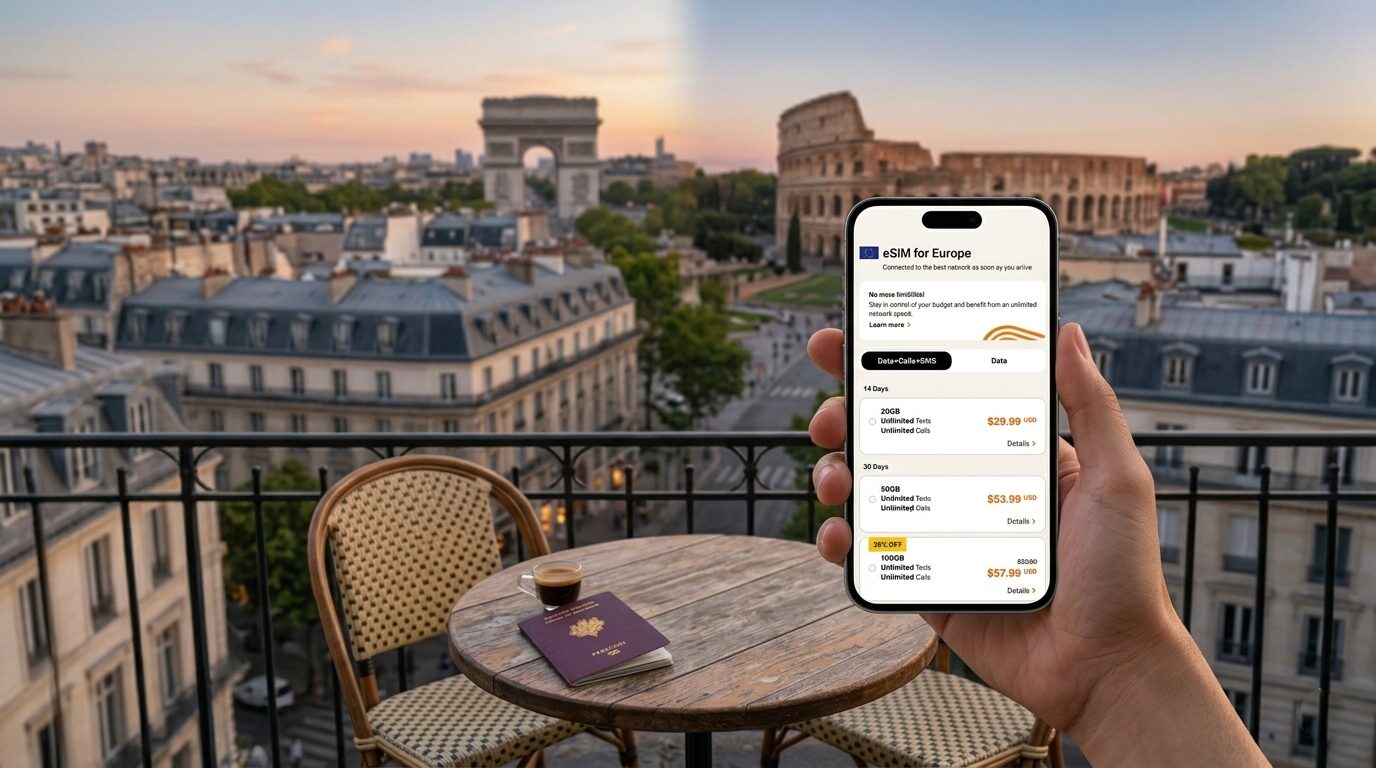
Why Switch to a Virtual SIM Card When Exploring Abroad

Your Go-To Guide for Using an eSIM While Traveling Abroad

An eSIM for travel is a digital SIM card embedded in your device, allowing you to instantly activate a mobile data plan in a destination country without needing a physical card. This technology lets you scan a QR code to connect to local networks upon arrival, bypassing the hassle of swapping SIMs at airport kiosks. The core value lies in its seamless connectivity, enabling you to keep your home number active while maintaining reliable local data for maps, booking, and communication throughout your trip.

Why Switch to a Virtual SIM Card When Exploring Abroad

Switching to a virtual SIM card when exploring abroad eliminates the hassle of physical swaps and the risk of losing your primary SIM. An eSIM for travel lets you purchase and activate a local data plan instantly upon arrival, avoiding expensive roaming fees. You keep your home number active for calls or 2FA while using a separate eSIM profile for data. Why switch? Simply put, it offers seamless connectivity without queuing at foreign kiosks. Q: How do I avoid unexpected charges? A: An eSIM for travel lets you control data costs with prepaid local plans, ensuring no surprise bills upon return. This one-device solution is the most convenient way to stay online abroad.

The Real Cost Difference Between Physical SIMs and Digital Profiles

When traveling, physical SIMs incur hidden costs beyond the purchase price, such as shipping fees for pre-ordered cards or wasted money on unused local plans. Digital profiles eliminate these, allowing you to buy only the exact data you need, often at lower base rates. The real cost difference becomes stark when roaming: a physical SIM can trigger expensive daily surcharges from your home carrier, while an eSIM enables switching to a local profile instantly, avoiding those fees. This makes eSIM cost efficiency superior, as you pay only for active, tailored connectivity.

How Instant Activation Eliminates Airport Kiosk Hassles

Forget the maddening airport kiosk shuffle. With a travel eSIM, instant activation eliminates airport kiosk hassles entirely. You land, turn on your phone, and your data plan is already live. No hunting for a crowded kiosk, no fumbling with tiny physical SIM trays, and no risk of losing your home SIM. You skip the line completely, stepping straight into the arrivals hall already connected to local networks. This means zero downtime after a long flight; you can call a ride, check directions, or message family immediately, transforming a frantic arrival into a seamless, stress-free start.

Keeping Your Home Number Active While Using a Local Data Plan

Using an eSIM means you can keep your home number active for essential texts and calls while relying on a local data plan for the heavy lifting. Dual SIM dual standby lets your primary line receive SMS for bank verifications or WhatsApp messages even when using foreign internet. This avoids missing critical 2FA codes or family alerts. Just disable cellular data on your home line and set data roaming only on the local eSIM profile.

  • Enable Wi-Fi Calling on your home number to avoid per-minute charges.
  • Set your home line to “use other line for data” to prevent accidental charges.
  • Forward calls to a VoIP service if you want a single number for pickup.
  • Keep your home SIM’s texts active by leaving the line on, even on low power mode.

Top Destinations Where This Technology Saves You the Most

For travelers, esim for travel provides the most savings in destinations with fragmented and expensive local carriers, such as the United States, where a single regional data plan can cost over $10 per GB. In Japan and South Korea, prepaid physical SIMs often require complex registration and high airport kiosk markups, while eSIMs offer immediate, cheaper connectivity. Across the European Union, a single eSIM plan bypasses roaming surcharges between countries like France and Italy, which is a major cost advantage. Similarly, in Australia and New Zealand, where coverage is spread across multiple pricey providers, an eSIM provides a flat fee for nationwide access. These are the top destinations where this technology saves you the most money and hassle, as eSIMs eliminate physical SIM costs and currency exchange losses.

Europe’s Multi-Country Passes for a Seamless Train Journey

For seamless rail travel across borders, Europe’s multi-country passes like Eurail or Interrail are essential. An eSIM ensures you can instantly activate digital tickets and navigate platform changes without hunting for local SIMs. To maximize savings and connectivity:

  1. Purchase the pass and a regional Europe eSIM before departure to avoid roaming fees.
  2. Use the train operator’s app to book advance seat reservations directly from your device.
  3. Download offline maps for tunnels or low-signal zones en route.

This pairing eliminates connectivity gaps between countries, letting you board high-speed trains from Paris to Rome with a single digital setup.

Asia’s High-Speed Networks Without Contract Lock-Ins

For travelers, Asia’s high-speed networks are a major draw because local eSIM providers offer full-speed LTE and 5G access without requiring contract lock-ins. In Japan and South Korea, you can purchase a data-only eSIM valid for 7 or 14 days immediately upon landing, then discard it without penalty. In Singapore and Thailand, prepaid eSIMs connect to the best local towers (e.g., Singtel or AIS) for seamless streaming and navigation. To activate:

  1. Scan the QR code from a provider like Airalo or Holafly before departure.
  2. Select a short-term plan (e.g., 1GB per day).
  3. Top up or switch providers next trip without any cancellation fees.

esim for travel

Remote Regions Where Offline Maps and Stable Connections Matter

In remote regions like Patagonia, the Sahara, or the Scottish Highlands, offline maps become essential because cellular towers are sparse or non-existent, while stable connections matter only at sporadic hubs. eSIM technology lets travelers pre-download detailed map data before departure, ensuring navigation remains functional without roaming. A single eSIM profile can switch between local providers at border crossings, maintaining data access where physical SIM swaps are impractical. Reliable offline navigation in remote zones prevents costly detours when signals fail. Q: Why prioritize offline maps in these regions? A: Because trail signage is rare and weather can block satellite signals, making pre-loaded eSIM maps your primary safety tool.

Choosing the Right Data Package for Your Itinerary

Match the eSIM data package to your specific travel style, not just trip duration. For a week of city hopping with heavy navigation and social media, a 5-10 GB regional plan suffices. If you’re working remotely or streaming daily, opt for an unlimited or 20+ GB package. Always check if the plan includes hotspot tethering if you need to connect a laptop. Q: How do I estimate data for a two-week road trip with light use? A: Choose a 3-5 GB regional package; you’ll save money and can top up via the provider’s app if maps or streaming drain it faster than expected, ensuring you never pay for unused gigabytes.

Short Tourist Trips vs. Long-Term Backpacking Needs

For short tourist trips, a regional or global eSIM with a fixed data cap (e.g., 1–5 GB) and a 7–14 day validity often suffices, prioritizing cost-per-GB over flexibility. In contrast, long-term backpacking needs demand a top-up-capable eSIM with rollover data or multi-month plans to avoid frequent repurchases. A tourist can preload a single package; a backpacker must assess daily usage patterns—navigating maps, social media, and booking apps—while budgeting for connectivity in remote zones where speed tiers shift. The choice hinges on itinerary pace: fixed data suits static sightseeing, whereas scalable allowances adapt to unpredictable, extended travel.

  • Short trips favor prepaid, non-renewable data with high per-day allowances.
  • Long-term travel requires eSIMs with flexible renewal options and low long-term costs.
  • Tourists prioritize coverage in urban hubs; backpackers need rural network compatibility.
  • Backpackers must evaluate data throttling policies for continuous streaming versus intermittent use.

Unlimited Data vs. Tiered Plans for Social Media Uploads

For frequent social media uploads while traveling, an unlimited data eSIM plan is often superior to a tiered one. Uploading high-resolution images and videos rapidly consumes gigabytes, making tiered data pools risky and prone to costly overage charges. An unlimited plan provides constant upload capacity, allowing you to share content seamlessly without monitoring your balance. Conversely, tiered plans suit light users who post only text or compressed files. The table below contrasts these practical aspects.

Aspect Unlimited Plan Tiered Plan
High-res video uploads Support without limits Fast depletion of data
Overage risk None High if posting daily
Cost predictability Fixed fee Varies with usage

Voice Calling Add-Ons for Booking Local Services

When selecting an eSIM data package for travel, consider voice calling add-ons specifically for booking local services, as many providers require a phone number for reservation confirmations or last-minute changes. A local voice add-on ensures you can call tour operators, restaurants, or taxi dispatchers directly without relying on unstable VoIP apps. Choose packages that offer a few prepaid minutes rather than unlimited data, as these are cheaper and sufficient for short calls. Verify the add-on includes local toll-free or standard numbers, which are common for service booking. This approach prevents connectivity gaps when confirming a pickup or altering a dinner reservation.

esim for travel

Voice calling add-ons on travel eSIMs provide a reliable, low-cost way to directly contact local service providers for booking confirmations and real-time communication.

Device Compatibility Checks Before You Depart

Before your trip, confirm your device is eSIM compatible by checking your phone’s settings for “Add eSIM” or verifying the model on your carrier’s site. Most newer models (iPhone XS and later, Google Pixel 3 and newer) support eSIM, but regional variants may be locked. Ensure your device is carrier-unlocked to avoid activation failures abroad. If you bought your phone through a specific network, confirm they permit eSIM travel profiles; some older or non-flagship models lack the required hardware. This five-minute check prevents wasting time troubleshooting incompatible tech at your destination. A fully prepared device lets you install and activate your travel eSIM instantly, so you stay connected from touchdown.

Verifying Carrier Unlock Status on Your Current Phone

To use an eSIM for travel, your current phone must be carrier-unlocked. First, go to **Settings > General > About** and look for „Carrier Lock.“ If it says „No SIM restrictions,“ you’re ready. If locked, contact your carrier to request an unlock, which often requires the phone to be paid off and active for a set period. Once unlocked, restart your device to finalize the change. Follow this sequence to ensure success:

  1. Navigate to the „About“ section in your phone’s settings.
  2. Confirm that „Carrier Lock“ shows „No SIM restrictions.“
  3. If locked, submit an unlock request through your carrier’s website or customer service.
  4. Restart your phone after receiving confirmation to apply the unlock.

Recent iPhones, Pixels, and Samsung Models That Support Dual eSIMs

Recent iPhones, starting with the iPhone XS and including the iPhone 13 and 15 series, support dual eSIMs, allowing you to activate a travel plan while keeping your home line active. Google Pixel models, from the Pixel 5 onward, offer dual eSIM capabilities, ideal for simultaneously using a local data eSIM and your primary number. Samsung’s Galaxy S10 and newer S and Z series handsets also support dual eSIMs, enabling you to manage two profiles easily. For seamless travel connectivity, verifying your device’s compatibility with dual eSIMs is essential before departure.

What to Do If Your Handset Lacks This Feature

If your handset lacks eSIM capability, you must first confirm it is carrier-unlocked for physical SIM use. Purchase a travel SIM card compatible with your destination’s network bands, or use a global roaming physical SIM from an eSIM provider that offers a hybrid solution. Some carriers allow you to convert an existing physical plan into a temporary eSIM on a new device, but this is not a workaround for an incompatible phone. Alternatively, consider a portable Wi-Fi hotspot device with a local data plan, which bypasses the handset’s limitation entirely.

Step-by-Step Setup Without a Physical Store Visit

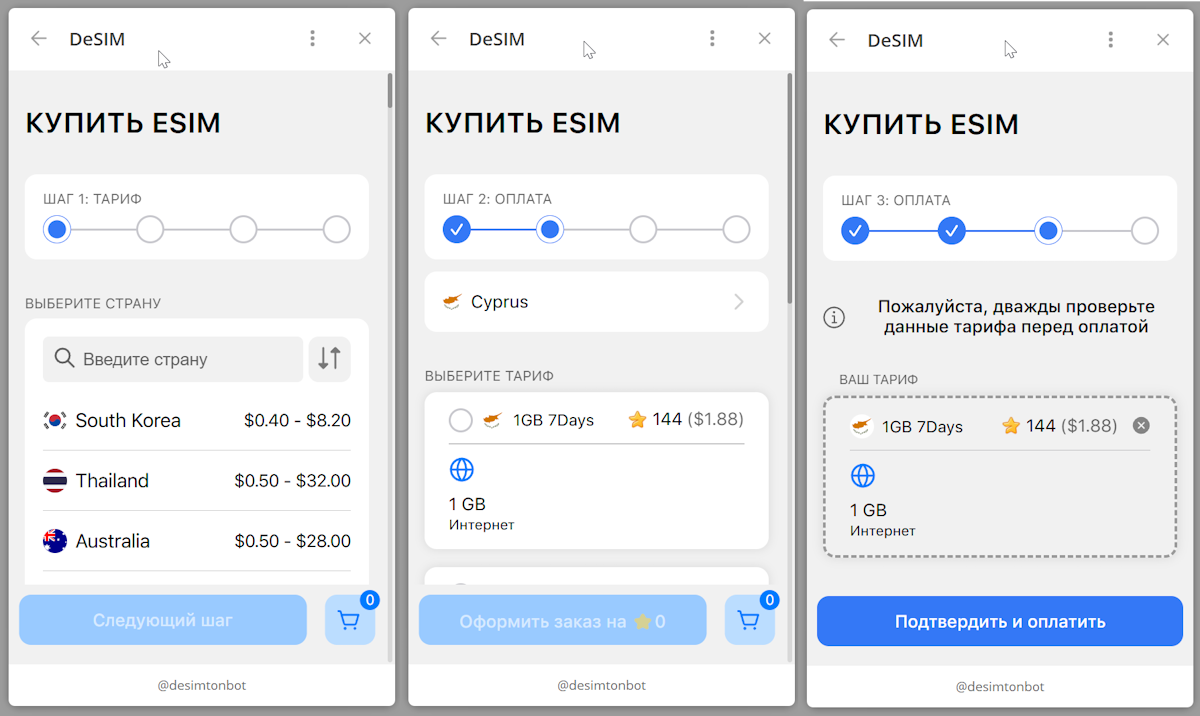
Setting up an eSIM for travel without a physical store visit begins by checking device compatibility in settings. Next, purchase a plan from a provider’s website or app, receiving a QR code or download link instantly. On the device, go to cellular settings, select „Add eSIM,“ and scan the QR code or enter details manually. Installation completes in under two minutes, with the profile activating upon arrival at the destination, often requiring a network selection restart. No physical SIM removal is needed, and multiple plans can coexist on one device.

Scanning a QR Code from Your Provider Email

After purchasing an eSIM plan, your provider will send a setup email containing a unique QR code. To activate your travel data, locate this email on your phone or a secondary device. Open your device’s settings, navigate to “Cellular” or “Mobile Data,” and select “Add eSIM.” Choose the option to scan a QR code, then point your camera at the code in the email. Ensure you have a stable Wi-Fi connection for this eSIM QR code activation step. The profile will download automatically; follow prompts to label it (e.g., “Travel Data”) and set it as your primary data line, if desired.

Manually Entering Activation Codes for Older Phones

For older phones lacking native eSIM support, manually entering activation codes remains the primary method for digital setup. You receive a QR code or alphanumeric activation string from your eSIM provider via email; navigate to your device’s mobile network settings and select “Add Cellular Plan” or “Enter Activation Code.” With legacy handsets, you may need to manually paste the SM-DP+ address and activation code into separate fields, bypassing the QR scanner if unavailable. Older Android models often require restarting twice to register the eSIM profile fully after manual entry. This approach avoids physical store visits, enabling direct eSIM provisioning for travel on hardware without integrated profile download support.

Manually entering activation codes allows older phones to access eSIM travel plans by inputting provider-supplied details directly into device network settings.

Switching Primary and Secondary Lines Mid-Trip

You can swap your primary and secondary line roles mid-trip to control data usage and caller ID. In your device’s cellular settings, designate your travel eSIM as the primary line for data, while keeping your home SIM as the secondary line for iMessage and SMS fallback. This switch keeps your home number active for verification codes without incurring roaming charges. Always test the new data connection before leaving Wi-Fi, as some carriers require a brief network refresh.

Switching primary and secondary lines mid-trip lets you route data through your travel eSIM while preserving your home number for critical messages, avoiding roaming fees.

Common Pitfalls and How to Avoid Them

A major pitfall is assuming all eSIMs activate instantly; many require a stable Wi-Fi connection to download the profile, so do this before departure. Activation blunders also arise from selecting the wrong local network manually after installation—your device should default to automatic, but double-check. Another common error is forgetting to remove your primary SIM’s data roaming to avoid unexpected charges. Q: Why does my data stop working midway through the trip? A: You likely hit a fair-usage cap or the plan expired; check your plan’s duration and throttle limits before traveling. To avoid frustration, always test the eSIM immediately after installation and keep a screenshot of your plan details.

Accidentally Incurring Roaming Charges from Your Home Carrier

esim for travel

A primary pitfall when using an eSIM for travel is accidentally incurring roaming charges from your home carrier. This happens when your primary physical SIM or eSIM remains active, allowing your home network to latch onto a foreign tower. Before activating your travel eSIM, manually disable your primary line in your device’s settings—simply adding a travel plan does not automatically block your home SIM. If you need to keep your home number reachable for SMS, turn off data roaming explicitly for that line; otherwise, a single incoming MMS or background app refresh can trigger daily fees.

Q: How can I prevent my home carrier from billing me if I keep my primary SIM active with an eSIM?
A: In your phone’s cellular settings, set your primary line to “off” for data roaming and confirm it uses no mobile data. For absolute safety, select your travel eSIM as the sole data line and disable “Allow Cellular Data Switching,” which prevents the phone from borrowing data from your home SIM in weak signal spots.

Running Out of Data When You Need Emergency Navigation

Running out of data during emergency navigation is a critical pitfall when relying on eSIMs for travel. You must preemptively download offline maps within your navigation app while data is still active, as eSIM data cannot be spontaneously topped up in areas with zero cell signal. Furthermore, prioritize an eSIM plan with a generous data allowance and set a hard data alert on your device at 80% usage. This ensures a buffer remains for re-routing or accessing location coordinates if you become stranded. Emergency navigation offline maps are your only reliable backup when mobile connectivity fails.

Always secure offline maps before departure to avoid being stranded without data for emergency navigation.

Provider Restrictions in Countries Like China or Turkey

When traveling to countries like China or Turkey, your eSIM may fail if the provider lacks local partnerships. Provider restrictions in countries like China or Turkey often block certain foreign eSIMs entirely, leaving you without service upon arrival. To avoid this, verify your eSIM provider explicitly supports these markets before purchasing. Many popular global plans exclude these regions, forcing reliance on local physical SIMs.

  • Check provider coverage maps specifically for China or Turkey, not general „global“ claims.
  • Purchase eSIMs from providers who partner directly with local carriers like China Mobile or Turkcell.
  • Activate your eSIM before entering restricted countries to avoid connectivity gaps at borders.
  • Consider a second eSIM from a dedicated regional provider as a backup in case of restrictions.

Comparing Major International Data Providers

When comparing major international data providers for your travel eSIM, focus on coverage maps versus real-world speed. Airalo often wins for budget-friendly single-country plans, but Holafly beats it with unlimited data in popular tourist spots. For multi-region trips, Ubigi consistently offers faster 5G speeds than Nomad, though Ubigi’s plans are pricier. Check if your provider uses local carriers in each country—some eSIMs throttle to 3G after a data cap.

A key insight: always verify if the eSIM allows hotspot sharing, as many budget providers restrict it, forcing you to rely on your phone’s connection alone.

Finally, read recent user reports for each destination; coverage varies wildly even within the same provider’s network.

Airalo’s Regional Coverage vs. Holafly’s Unlimited Plans

When comparing Airalo’s regional coverage versus Holafly’s unlimited plans, the choice hinges on your travel style. Airalo excels for multi-country trips, offering affordable, data-only regional eSIMs that save you from buying separate local SIMs across several nations. Holafly, however, dominates for heavy data users in a single country, providing truly unlimited high-speed data, often with a local number, eliminating any fear of throttling. If your itinerary spans borders, Airalo’s cost-effective regional bundles are superior; if you binge-stream in one destination, Holafly’s uncapped plans win.

In summary, choose Airalo’s regional coverage for budget-friendly multi-country travel, and choose Holafly’s unlimited plans for unthrottled, heavy usage in a single country.

GigSky’s Global Passes for Business Travelers

GigSky’s Global Passes for Business Travelers offer a single eSIM plan covering 190+ countries, eliminating per-destination setup. These passes prioritize high-speed data for corporate itineraries, with tiered 1GB, 3GB, or 5GB options that activate immediately upon arrival. For multi-stop trips, the pass provides a continuous connection without swapping profiles. To deploy it:

  1. Purchase a Global Pass through the GigSky app before departure.
  2. Install the eSIM profile using a device QR code.
  3. Enable data roaming upon landing; the pass auto-detects local networks.

Local Carrier Offers That Beat Generic Tourists SIMs

Local carrier eSIM offers often outperform generic tourist SIMs by providing access to native network infrastructure rather than throttled wholesale bandwidth. This means faster data speeds and lower latency during peak hours, as you are prioritized alongside domestic users. Direct local carrier plans frequently include features absent from generic options, such as tethering allowances, free incoming calls within the country, or access to local streaming services without geoblocks. The pricing for high-volume data bundles (e.g., 50GB+) can also be substantially cheaper per gigabyte than a generic regional plan.

Why would a local carrier offer better in-country connectivity than a generic tourist SIM? Because local carriers maintain direct peering agreements and dedicated infrastructure within that market, whereas generic SIMs often route traffic through a third-party aggregator, introducing extra latency and potential congestion.

esim for travel

Security and Privacy Advantages of Digital Profiles

Digital profiles for travel eSIMs sever the link between your physical identity and mobile access. Instead of handing a passport to a foreign kiosk clerk, your profile is encrypted and stored locally, making it useless if your device is stolen. This eliminates sim-swap risks entirely, as the profile is bound to your device’s secure element and requires biometric authentication to activate.

Even if a thief extracts the phone’s hardware, your travel connectivity remains locked behind your face or fingerprint, not a vulnerable SIM tray.

Your home number stays dormant, preventing sensitive message interception abroad, while the temporary profile auto-expires, leaving zero roaming traces on foreign networks.

No Need to Hand Over Your Physical SIM to Strangers

When traveling with an eSIM, you eliminate the risky act of physically handing your SIM card to a foreign vendor or convenience store clerk to activate local service. This prevents strangers from cloning your card or accessing your primary number. You simply scan a QR code or download a profile, keeping your physical SIM secure in your device or at home. This practice directly avoids potential identity theft or unauthorized use of your mobile account abroad. Eliminating physical SIM card exchanges is a core privacy safeguard. Q: Can a stranger still access my data during eSIM activation? A: No, because you handle the entire digital provisioning process yourself, never surrendering any physical hardware to a third party.

Remote Wiping Capabilities if Your Device Gets Lost

If your device is lost while traveling with an eSIM, remote wiping capabilities let you erase the eSIM profile and all associated data from afar via your carrier’s app or web portal. This immediately severs network access, preventing unauthorized usage or charges. Because an eSIM is not a physical card, wiping it also removes the traveler’s account credentials and any stored contacts, unlike removing a physical SIM where residual data may remain. The action is typically irreversible, ensuring complete data sanitization. You must pre-configure remote wipe access—often through a backup phone or laptop—before losing the device to ensure you can execute the command. Timing is critical: wipe before the thief connects to Wi-Fi.

Encrypted Connections Through Native Carrier Profiles

When you activate an eSIM for travel, the encrypted carrier profile is provisioned directly to your device’s secure element. This native profile establishes a direct, encrypted tunnel between your phone and the carrier’s network, bypassing public Wi-Fi or open hotspots. Unlike a physical SIM, which can be cloned or intercepted during insertion, the eSIM’s native profile uses embedded cryptographic keys for mutual authentication. The encryption protects your connection data—such as IMEI and network access tokens—during roaming handovers. For a traveler, this means your data session on foreign networks remains shielded from local intercepts without relying on VPN configuration. The setup process follows a clear security sequence:

  1. Download the encrypted profile from a secure server via a dedicated app or QR code.
  2. The device verifies the profile’s digital signature before storing it in tamper-resistant hardware.
  3. Every subsequent connection to the carrier uses the profile’s stored credentials for session encryption.

Managing Multiple Lines for Work and Leisure

When traveling, juggling Managing Multiple Lines for Work and Leisure with an eSIM means you can keep your home number for banking alerts while adding a local data plan for exploring. This lets you Slack your boss on one profile and scroll TikTok on another, without swapping physical SIMs. The real trick is labeling them clearly on your device—“Work“ and „Play“—so you don’t accidentally answer a client call from a hike.

Set a default line for iMessage or WhatsApp to avoid confusion; it keeps your after-hours memes separate from your spreadsheets.

Just toggle data or calls per line in settings to switch from conference calls to cafe hopping.

Keeping a Business Number Accessible While on Vacation

Keeping a business number accessible while on vacation is seamless with an eSIM, allowing you to field urgent client calls via a secondary profile. Your primary work line remains operational for essential communications, while a travel eSIM handles local data costs. This setup ensures uninterrupted business accessibility without roaming fees. Respond to critical messages through apps linked to your number, keeping your leisure time undisturbed. Adjust your voicemail to indicate limited availability, and schedule brief check-in windows to maintain professionalism.

  • Enable call forwarding from your business number to your eSIM data line
  • Use a single phone with dual eSIM profiles for work and travel
  • Mute work notifications during defined leisure hours
  • Set an automatic SMS reply with your return date

Using a Travel Number for Ride-Sharing Apps Only

Using a travel eSIM line solely for ride-sharing apps offers a logical China eSIM separation from your primary number. You install a local data plan on your eSIM, then configure apps like Uber or Lyft to use that specific line for verification and communication. This prevents your home number from being exposed to hundreds of drivers, reducing spam risk. The practical advantage is that the travel number remains active only for pickups and drop-offs, while your work line stays dormant. For a single-purpose setup, this approach is simpler than managing a full second line, though it requires ensuring the travel eSIM has sufficient data for in-app messaging.

Not applicable—a comparison table is unnecessary here, as the subtopic focuses on a single, specific use case rather than multiple comparable aspects.

Pausing and Reactivating Plans Without New Purchases

Many travel eSIM providers let you pause and reactivate plans without new purchases, saving money between trips. You simply turn off the data line in your settings, and your remaining days pause. This works best with providers offering flexible validity, not fixed-day plans. When you’re ready to travel again, toggle the line back on—no repurchase needed. Always check if your plan supports pauses, as some only allow one reactivation before expiry.

Pausing and reactivating your eSIM plan without buying new data is a handy way to stretch your balance across multiple trips.

What Exactly Is a Travel eSIM and How Does It Work

The Core Technology Behind Skipping Physical SIM Cards Abroad

How Activation Happens: Scanning a QR Code vs. Manual Setup

Key Benefits of Using a Digital SIM Over a Local Physical SIM

Switching Networks Without Fumbling with Tiny Cards

Keeping Your Home Number Active While Using a Local Data Plan

How to Choose the Best eSIM Plan for Your Destination

Evaluating Data Allowances vs. Duration for Short Stays and Long Trips
esim for travel

Why Coverage Maps and Local Carrier Partnerships Matter Most

Step-by-Step Guide to Installing and Activating Your Digital SIM

Checking Device Compatibility Before You Leave Home

Purchasing, Downloading, and Enabling the Profile Correctly

Top Tips to Maximize Performance and Avoid Surprise Charges

Managing Dual SIM Settings for Calls, Texts, and Data Priority

When to Use Public Wi-Fi vs. Your Mobile Data to Stretch Your Plan

Common Problems Travelers Face and Simple Fixes

What to Do If Your Network Profile Doesn’t Show Up

Why Your Connection Might Lag in Different Regions and How to Adjust

Why Travelers Are Switching to Digital SIMs

The Best eSIM for Travel in 2024: My Top Picks for Stress-Free Data Abroad

The best eSIM for travel is a digital SIM card that lets you instantly connect to local networks abroad without fumbling with tiny plastic cards. You simply scan a QR code or download a plan before your trip, activate it upon arrival, and enjoy affordable data in your destination. This eliminates roaming fees and the hassle of swapping physical SIMs, letting you use maps and stay in touch right away. It’s the easiest way to get online while exploring new places.

Why Travelers Are Switching to Digital SIMs

best esim for travel

Travelers are switching to digital SIMs for travel because they eliminate the hunt for local physical SIMs at airports or kiosks, saving time and reducing hassle. The best eSIM for travel offers instant activation before departure, allowing you to connect immediately upon landing. This removes the risk of losing your primary physical SIM card, a common traveler anxiety. You maintain your home number for calls and banking while accessing local data networks for navigation, translation, and ride-hailing. This dual-line capability, combined with flexible data plans for multiple countries, makes a single eSIM far more convenient than juggling multiple physical cards or renting pocket WiFi.

Traditional roaming vs. eSIM: cost, convenience, and coverage

Traditional roaming ties you to expensive daily fees from your home carrier, while eSIMs unlock local pricing instantly, slashing your connectivity costs. Convenience flips entirely: roaming requires a physical SIM swap or carrier permission, whereas an eSIM lets you download a plan before you board. For coverage, roaming piggybacks on your provider’s partner networks, often throttling speed; eSIMs let you pick local carriers in each country, guaranteeing stronger signals. This shift makes choosing an eSIM for travel the clear winner for budget-conscious adventurers who want seamless, global connectivity without airport kiosk hassles.

How eSIM technology eliminates physical SIM swaps

For travelers, eSIM technology eliminates the need for physical SIM swaps entirely. Instead of hunting for a paperclip to eject a tray or risking a lost nano-SIM mid-trip, you simply scan a QR code or install a profile via an app. This remote provisioning instantly activates a local data plan while keeping your primary number active. No more fumbling with tiny cards in airport terminals or juggling multiple physical SIMs. You switch networks digitally, changing providers for better coverage in seconds without touching your phone. The process is seamless, direct, and eliminates the hassle of carrying, storing, or damaging fragile plastic SIMs.

Key Factors When Choosing a Mobile Data Plan Abroad

When snagging the best eSIM for travel, focus first on data allowance versus your actual habits—streaming drains gigs fast, while maps and messaging sip them. Check if the plan covers all your destinations without extra add-ons, since multi-country eSIMs avoid juggling multiple codes. Peak hour throttling can quietly ruin your trip, so read the fine print on “unlimited” offers. Also, ensure the app lets you top up easily mid-journey; real-time management beats buying a new plan when you run low. Speed caps matter less for social media, but essential for video calls or work backups.

Network compatibility and supported devices

Before you buy an eSIM for travel, double-check your phone actually supports it. Device compatibility is non-negotiable, as most US and EU models from iPhone XR onward work, but many budget or older Android phones don’t. After confirming your device, check that the eSIM provider connects to local networks in your destination—some plans only roam on one carrier, which can mean spotty coverage in rural areas. To test this before committing:

  1. Look up which local 4G/5G bands the eSIM supports.
  2. Verify your phone matches those bands using its spec sheet online.
  3. Read user reports about network performance in cities versus countryside.

Data limits, speed caps, and throttling policies

When selecting the best eSIM for travel, scrutinize data limits precisely; plans touting „unlimited“ data almost always enforce a strict speed cap after a threshold, throttling you to unusable 2G or 128kbps. High-speed caps vary dramatically—a 10GB plan might throttle immediately upon hitting the limit, while premium plans reduce speeds gradually. Always check the „fair use“ policy wording to avoid sudden, harsh throttling that cripples navigation or messaging. Confirm whether a plan offers a „soft cap“ (slower but functional) or a „hard cap“ (zero data) after the high-speed quota is exhausted.

Effective travel eSIMs define clear data limits, enforce predictable speed caps, and avoid aggressive throttling that renders basic connectivity useless.

Duration flexibility: short trips versus long-term stays

Duration flexibility determines whether a plan suits a weekend getaway or a months-long relocation. For short trips versus long-term stays, choose an eSIM offering daily, weekly, or monthly validity without lock-in contracts. Short trips benefit from prepaid data packs (e.g., 1–7 days) that auto-expire, avoiding unused credit. Long-term stays require plans renewable every 30 days or with pause features to prevent billing gaps. To match your itinerary:

  1. Confirm the eSIM’s maximum validity (e.g., 30/90/365 days).
  2. Check if top-ups extend the original plan or start a new period.
  3. Verify if unused data rolls over between renewals for extended travel.

Top Global Providers for Seamless Connectivity

After landing in Marrakech, my physical SIM was useless, but the best eSIM for travel from Airalo had me on local 4G instantly. Later, in a remote Tokyo alley, Holafly’s unlimited data let me navigate without hunting for Wi-Fi. For a week in rural Costa Rica, Nomad’s multi-country plan kept me connected across borders without reconfiguring settings. These Top Global Providers for Seamless Connectivity each solved a different journey: Airalo’s cheap regional passes for budget trips, Holafly’s high-speed cap for heavy streaming, and Nomad’s flexible top-ups for itineraries that shift daily. No registration hassles, no swapping cards—just a QR code scan and instant roaming.

Airalo: widespread regional and country-specific plans

Airalo shines as a top pick for best esim for travel because it offers both widespread regional plans, like covering all of Europe or Asia, alongside hyper-specific country-specific plans for places like Japan or Brazil. This lets you pick a cheap regional bundle if you’re hopping countries, or a local one for deep data dives in a single nation. Q: What if I’m visiting multiple countries in one region? A: Grab Airalo’s regional plan—it seamlessly covers all those spots, so you don’t need to install new eSIMs every time you cross a border.

Holafly: unlimited data options for heavy users

For heavy users, Holafly’s unlimited data eSIM plans eliminate the anxiety of tracking megabytes while traveling. You can stream high-definition video, conduct video calls, and navigate with live traffic maps all day without exceeding a cap. The primary practical trade-off is a fair-use policy that throttles speeds after a large daily threshold, typically around 2GB per day, during continuous high-bandwidth activity. This still provides reliable, usable connectivity for maps and messaging even after the threshold. Holafly does not offer a pay-per-data top-up; you purchase a fixed-duration unlimited plan upfront. This structure best suits travelers who prioritize constant access over cost-per-gigabyte efficiency, avoiding the hassle of monitoring a finite balance.

Ubigi: reliable coverage across multiple continents

For travelers seeking consistent performance, Ubigi stands out for reliable coverage across multiple continents. Its eSIM automatically connects to strong, local networks in regions like Europe, Asia, and North America, minimizing the risk of dropped signals. The service focuses on stable LTE/5G data for essential navigation and communication. A key advantage is its seamless switching between countries without requiring a new eSIM, ensuring uninterrupted connectivity during multi-stop trips. This practical stability makes Ubigi a dependable choice for those prioritizing consistent access over budget-focused plans.

Flexiroam: unique app-based data management

Flexiroam differentiates itself in the best eSIM for travel category through its unique app-based data management platform. Rather than relying on standard device settings, you purchase and activate virtual data packs directly within the Flexiroam app, which then manages your connection layers. This allows you to switch between local networks without swapping physical cards or adjusting phone configurations. The interface displays real-time usage and offers one-tap top-ups, giving you precise control over your data consumption. How does Flexiroam’s app-based system prevent roaming charges? It routes your data through its cloud platform, effectively bypassing your home carrier’s roaming tariffs while you maintain your primary SIM for calls.

best esim for travel

Regional Specialists Worth Considering

When evaluating the best eSIM for travel, regional specialists often outperform global providers for targeted coverage and value. Airalo offers robust Asia-focused packs, including reliable Japan and South Korea plans with high-speed data from local carriers. Nomad excels for European travel, providing tailored multi-country passes that bypass throttling common in universal plans. For Latin America, consider Holafly’s unlimited data options, though be aware of tethering restrictions. An Africa specialist like MTX Connect can be essential for consistent connectivity across patchy infrastructure. These specialists optimize pricing and network priority precisely where you need it, making them the practical choice for single-region trips.

best esim for travel

Europe-focused eSIMs: Orange Holiday and Vodafone

For travelers needing reliable connectivity across multiple Schengen countries, the Europe-focused eSIMs: Orange Holiday and Vodafone are primary contenders. Orange Holiday offers generous data allowances with a fixed validity period, ideal for a single extended trip, while Vodafone’s eSIM provides more flexible top-ups and often superior coverage in Eastern Europe. The critical differentiator is Orange’s network priority on its own infrastructure versus Vodafone’s reliance on partner networks in some regions. Both support hotspot tethering and easy activation via app, but you must verify specific country inclusion before purchase, as coverage maps vary.

Orange Holiday suits high-data users on a consolidated itinerary; Vodafone favors travelers needing modular, top-up-friendly plans across varied European sub-regions.

Asia-Pacific leaders: Singtel and HKBN CloudSIM

For travelers prioritizing the Asia-Pacific market, Singtel and HKBN CloudSIM stand out as focused regional specialists. Singtel’s eSIM leverages its direct ownership of infrastructure across Singapore, Australia, and Thailand, ensuring consistent high-speed LTE without third-party deprioritization. HKBN CloudSIM, conversely, specializes in multi-network aggregation across Hong Kong, mainland China, and Taiwan, offering failover between local carriers to maintain stability in congested areas. Where Singtel suits a single-destination trip requiring reliable speed, HKBN CloudSIM is preferable for itineraries spanning multiple APAC hubs, providing seamless connectivity through dynamic carrier switching.

best esim for travel

For pure APAC performance, Singtel excels in owned-network reliability, while HKBN CloudSIM delivers adaptive coverage across several markets via local carrier hopping.

North America standouts: T-Mobile and Verizon prepaid

For reliable eSIM coverage across the US and Canada, T-Mobile prepaid offers extensive 5G access on its native network, ideal for urban and suburban travel. Verizon prepaid eSIM excels in rural and remote regions where its network density is superior, though speeds may throttle after high-data usage. Both plans include unlimited talk and text within North America. T-Mobile’s „Simple Global“ data passes provide a straightforward top-up, while Verizon’s prepaid eSIM requires a US billing address for activation, making T-Mobile more accessible for short-term visitors seeking immediate activation for travel.

T-Mobile and Verizon prepaid eSIMs are top choices for North American travel: T-Mobile for easy setup and city coverage, Verizon for rural reliability and network depth.

Comparing Pricing Structures Without Hidden Fees

When evaluating the best esim for travel, direct provider comparisons often fail because most competitors bury activation fees, minimum top-ups, or „daily“ rates that auto-renew even on unused days. You must isolate plans that advertise a single, transparent total. The key is comparing pricing structures without hidden fees by checking the checkout page for mandatory „service charges“ or fine print requiring you to purchase a separate „starter“ data pack before the advertised plan activates. The best travel eSIMs display a flat, all-inclusive cost for a specific data amount and validity period, with no surprise „connection“ fees when you land. If a provider lists a price but makes you choose an „add-on“ to reach that speed, it is not a transparent structure. Focus only on plans where the visible price is the final price.

Pay-as-you-go versus fixed package rates

For travelers, choosing between pay-as-you-go and fixed package rates hinges on usage predictability. Pay-as-you-go vs fixed package rates dictate your spending control: pay-as-you-go offers unrivaled flexibility, topping up only when data runs low, ideal for light, sporadic use. Fixed packages lock you into a set data allowance upfront—perfect for heavy streamers who want foreseeable coverage without surprise deductions. With pay-as-you-go, you pay per MB, often costing more long-term but avoiding waste; fixed plans give a burst of high-speed data at a lower per-GB rate, then slow or stop. The best travel eSIM matches your root habit—moderate use favors fixed for value, erratic use favors pay-as-you-go for freedom.

Aspect Pay-as-you-go Fixed Package
Cost Control Top-up only as needed Paid upfront, fixed limit
Best For Light, intermittent data use Heavy, regular data consumption
Risk Higher per-MB rate if used often Waste if underuse allocated data
Flexibility Change plans mid-trip Locked amount until renewal

Cost per gigabyte across different providers

When hunting for the best esim for travel, the real trick is ignoring flashy total prices and focusing on true price per GB. A plan advertising 10GB for $20 might seem great, yet a regional provider like Airalo often charges $4.50 per gigabyte for spotty coverage, while Holafly packs 1GB at a higher $6.00 but includes unlimited (throttled) data. For short trips, Ubigi undercuts both at roughly $2.80 per gigabyte for a 10GB Japan plan. Always calculate your per-gig cost—a 1GB daily plan from a budget carrier might cost $3.00 per gig, but a 5GB weekly plan from the same provider could drop to $1.60 per gigabyte.

Provider Data Allowance Total Price Cost per Gigabyte
AirTM 10GB (Global) $45 $4.50
Holafly 10GB (Europe) $59 $5.90
Ubigi 5GB (Japan) $14 $2.80

Promo codes, referral discounts, and bundled deals

best esim for travel

When comparing eSIM pricing without hidden fees, examine how promo codes, referral discounts, and bundled deals actually reduce upfront costs. First, apply promo codes at checkout for instant percentage-off or free data bonuses. Second, leverage referral discounts by sharing your code with travel buddies—both you and the new user often earn $5–$10 credit. Third, prioritize bundled deals that combine multiple regions or long durations (like a 30-day Asia plan) over single-country packs. Follow this sequence:

  1. Search for active promo codes via newsletters or social media.
  2. Share your unique referral link before purchasing.
  3. Opt for regional or global bundles to lock in lower per-GB rates.

Always total the final price after applying these discounts to ensure no inflated base rates offset the savings.

Installation and Activation Made Simple

When you land in Tokyo, jet-lagged and searching for a train map, the best esim for travel removes all friction. Installation and Activation Made Simple means you scan a QR code at the gate or tap an email link mid-flight. Within thirty seconds, your phone connects to a local network—no SIM tray fiddling, no airport kiosk queues. I once watched a traveler activate theirs while their partner still fumbled with a physical card.

That moment—silent, immediate connectivity—turns a potential headache into smooth arrival.

The entire setup is digital: buy, scan, and you’re live before customs. No passwords, no account creations, just direct access from your layover lounge.

QR code scanning and manual profile setup

Most top-tier travel eSIM providers simplify installation through instant QR code scanning, which automatically downloads and activates your cellular profile upon arrangement. For devices lacking a camera or encountering scan failures, manual profile setup is equally straightforward: you enter the activation code details—typically an SM-DP+ address and confirmation code—directly into your phone’s mobile network settings. Both methods require a stable Wi-Fi connection during the initial configuration. Once applied, the eSIM appears as a secondary line, allowing you to keep your physical SIM active for calls while using the travel data plan immediately.

Importance of installing before departure

Installing your eSIM before departure eliminates connectivity gaps upon landing, as activation often requires a stable internet connection for initial profile download. Without pre-installation, travelers risk being stranded without maps or ride-sharing apps in unfamiliar airports. Pre-loading ensures the eSIM is ready to latch onto a local network immediately, bypassing the need to hunt for airport Wi-Fi or purchase a physical SIM. This proactive step also lets you verify compatibility with your device and test the connection while still at home. One failed activation attempt mid-journey can derail an itinerary; pre-departure setup protects against that.

Troubleshooting common activation errors

Even the best eSIM for travel can hiccup. First, ensure your device is unlocked and supports eSIM. If the profile won’t download, try a stable Wi-Fi connection and toggle airplane mode. A „No Service“ error usually means the APN settings are missing—manually add them from your provider’s email. If activation says „Failed,“ restart your phone, then scan the QR code again from your account dashboard. Most issues resolve by refreshing the connection.

  • Double-check your phone is unlocked and Japan eSIM eSIM-compatible before starting.
  • Manually input APN settings if data doesn’t work after installation.
  • Restart your device and re-scan the QR code for failed activations.
  • Use a strong Wi-Fi signal when downloading the eSIM profile.

Managing Multiple eSIMs on One Device

You land in Tokyo, fumbling to switch to your Japan data plan while keeping your home number active for banking codes. Managing multiple eSIMs on one device becomes your lifeline. The best eSIM for travel lets you store several profiles simultaneously, so you can download a local Japan package and a regional Asia plan before leaving home. In your phone’s settings, you toggle between them like apps—your primary line stays on for calls, while the travel eSIM handles data. The key trick: label each profile clearly (e.g., „JAPAN DATA“ and „HOME LINE“) to avoid sending an iMessage on the wrong plan. This way, you stream maps without swapping physical cards, and never miss a two-factor code from your bank back home.

Switching between primary and travel numbers

Switching between your primary number and a travel eSIM is a core convenience of modern trips. Most devices let you set your primary line for iMessage and FaceTime while assigning the travel eSIM solely for data, preventing roaming bills on your home number. You can instantly toggle which line handles calls and SMS for two-factor authentication. The dynamic trick is labeling each line precisely in your settings, so seamless travel number switching becomes a one-tap affair. This ensures you stay reachable on your home number for vital alerts while your travel eSIM powers navigation and local searches.

Dual SIM settings for voice and data separation

When you’re juggling a home SIM and a travel eSIM, the real trick is using your phone’s dual SIM settings for voice and data separation. You can set your home number for calls and texts while routing all mobile data through your travel eSIM, avoiding roaming charges. On an iPhone, go to Cellular > Cellular Data to pick your travel eSIM; for Android, dive into SIM Manager or Network Settings. Some phones also let you choose a “preferred SIM for calls” separately. Just remember, if you need to call home, your phone might still toggle data off briefly during the call—so test it before your trip to avoid surprises.

Storing backup profiles for future trips

For frequent travelers, storing backup eSIM profiles is critical to avoiding last-minute connectivity gaps. Before a trip, export each profile’s QR code or installation link as a secure PDF or password-manager entry. Store regional and global profiles separately, labeling them by destination and validity period. Never delete profiles with unused data, as they often reactivate on re-entry to the same region. On your device, keep at least one dormant local profile from a previous trip—it may offer better rates than a new purchase if you return unexpectedly.

Real-World Performance and User Reviews

When choosing the best esim for travel, real-world performance—not just advertised speeds—determines if you can actually stream route maps or upload trip photos. Travelers repeatedly report that Airalo delivers consistent 4G/LTE in major urban hubs, but reviews frequently note throttling during peak hours in dense spots like Tokyo or Paris, making browsing sluggish in crowded tourist zones. Conversely, Holafly’s unlimited plans earn praise for stable connectivity across rural landscapes, with videos loading smoothly where rivals falter. Critical user feedback highlights that download speeds often drop 30-50% from promised peaks, depending on local network congestion. For border-crossing trips, Nomad’s eSIMs attract favorable reviews for seamless switching, yet some travelers lament unreliable connections on remote islands despite strong coverage claims. Ultimately, scouring recent, location-specific user reviews on Reddit or Trustpilot is essential to avoid frustrating drops during critical navigation moments.

Speed test results in major tourist destinations

When checking speed test results in major tourist destinations, you’ll see huge gaps between providers. In Paris, local MVNOs often hit 150 Mbps downloads, while global roaming plans struggle at 20 Mbps. Rome’s Colosseum area shows 5G speeds of 200 Mbps on regional networks, versus 30 Mbps on budget travel SIMs. Tokyo’s Shibuya crossing typically delivers 180 Mbps on Japan’s premium eSIMs, dropping to 50 Mbps on discount options.

best esim for travel

  • Top-tier eSIMs average 150–200 Mbps in central London and Barcelona.
  • Budget eSIMs often drop below 10 Mbps in crowded spots like Times Square.
  • Mid-range providers offer steady 50–80 Mbps at major airports and train stations.
  • Peak hours in Cancún reduce speeds by half on all but the fastest data plans.

Customer service responsiveness across brands

In real-world travel, customer service responsiveness across brands separates seamless connectivity from travel chaos. For urgent issues like activation failures or lost data, Airalo often replies within hours via in-app chat, while Holafly’s 24/7 WhatsApp support delivers near-instant resolutions—a critical edge for time-sensitive travelers. Conversely, budget contenders like Ubigi may take over a day to respond, forcing users to troubleshoot alone. Users report sporadic multilingual support from Nomad, where live agents vanish during peak hours. To navigate this:

  1. Test the brand’s live chat during off-peak hours before your trip.
  2. Save screenshots of your eSIM purchase and error codes for quick agent reference.
  3. Prioritize brands with documented average response times under 15 minutes.

Reddit and travel forum consensus on reliability

Across Reddit and dedicated travel forums like TripAdvisor and Lonely Planet’s Thorn Tree, a clear consensus on eSIM reliability emerges: network switching capability is the benchmark. Users consistently report that single-network eSIMs frequently fail in rural areas or during congestion, while multi-network providers like Airalo and Holafly earn praise for maintaining connectivity by automatically hopping between local carriers. Reddit threads caution that anecdotal “perfect service” posts often lack geographic context, whereas forum veterans emphasize that reliability is region-specific, with certain eSIMs dominating in Europe but struggling in Southeast Asia.

Hidden Pitfalls and How to Avoid Them

A common pitfall is assuming „unlimited data“ means high-speed; many travel eSIMs throttle speeds after a small allotment. Always check the fair usage policy to avoid buffering maps and laggy Ubers. Another trap is buying a plan with no hotspot allowance, leaving you unable to share your connection with a laptop. Confirm tethering is included upfront if you rely on it. Also, avoid the mistake of activating the eSIM early; the clock often starts ticking immediately, not when you land. Some providers even charge for receiving non-downloaded setup instructions in roaming zones. Stick to top-rated apps from established telcos and read recent user reviews for the specific destination to sidestep these headaches.

Expiration dates and auto-renewal traps

When choosing the best eSIM for travel, expiration dates and auto-renewal traps require careful attention. Many travel eSIMs activate a timer the moment you install the plan, not when you first use data, causing your balance to vanish before your trip ends. Auto-renewal can quietly drain your account if you forget to disable it before the plan expires, often charging full price for a new cycle. To avoid these pitfalls, always check the activation window and plan duration before purchasing.

  • Read the fine print: some eSIMs must be installed within 30 days, or the plan expires unused.
  • Disable auto-renewal immediately after purchase in your account settings or app.
  • Set a calendar reminder to use data before the plan’s hard expiration date, not the flexible validity.

Data prioritization on congested networks

When networks are congested, not all eSIM data is equal. A travel eSIM from a premium network operator often receives higher priority than a mobile virtual network operator (MVNO) that rents capacity. This means your connection can slow to a crawl during peak hours if your eSIM relies on a low-priority carrier. To avoid this, check if your provider explicitly uses a major local network tier or offers „priority data“ in its terms. Apps that throttle video or background sync also help preserve usability during congestion.

Data prioritization determines your speed during congestion; choose an eSIM tied to a top-tier local network to avoid frustrating slowdowns.

Countries with limited eSIM support or restrictions

Even with the best eSIM for travel, certain destinations like China, Cuba, and Iran block international eSIM profiles entirely. Others, such as Turkey or Thailand, may restrict activation to local carriers only, causing connectivity gaps upon arrival. To avoid this, pre-verify eSIM coverage maps for your specific routes—global plans often fail in these zones. Purchase a physical local SIM as a fallback if your destination appears on restricted lists. This proactive check ensures your chosen provider isn’t rendered useless at customs.

Country Common Restriction
China Blocks all foreign eSIM profiles
Cuba No international eSIM available
Iran Local carrier activation mandatory
Turkey Foreign eSIMs often disabled

What Makes a Travel eSIM Different From a Physical SIM Card

How the Digital Profile Eliminates the Need for a Plastic Card

Why You Can Activate It Before You Even Leave Home

Key Features That Define a Top-Rated Travel eSIM

Coverage Across Multiple Countries on a Single Plan

Data-Only vs. Plans With a Local Phone Number

Flexible Duration Options From 24 Hours to 90 Days

How to Choose the Right Data Package for Your Trip

Matching Gigabyte Capacity to Your Daily Usage Habits

Understanding Speed Throttles After High-Speed Data Is Used

When to Pick a Regional Plan Over a Global One

Step-by-Step Guide to Installing and Activating Your First Plan

Checking Your Phone’s Compatibility Before Purchase

Scanning the QR Code or Installing via an App

Setting the Travel Profile as Your Primary Data Source

Practical Tips to Save Money and Stay Connected Abroad

Topping Up or Buying a New Plan While Already Traveling

Keeping Your Home SIM Active for Two-Factor Authentication

What to Do If You Experience Connection Issues in a New Country

What Sets Modern Embedded SIM Services Apart from Physical Cards

Best eSIM Data Plans for International Travel in 2025

An eSIM data plan is a digital profile that lets you connect to a mobile network without needing a physical SIM card. You simply download and activate the plan directly on your device, often through a quick scan of a QR code, instantly freeing you from swapping tiny cards. This setup means you can hop onto a local network while traveling or add a second line for work, all with the convenience of managing everything from your phone’s settings.

What Sets Modern Embedded SIM Services Apart from Physical Cards

Modern embedded SIM services eliminate the physical card, letting you switch or add an eSIM data plan instantly via software profile downloads. Instead of waiting for a SIM to ship or inserting a new card, you activate a plan in minutes through an app or QR code. This allows storing multiple carrier profiles simultaneously, enabling seamless switching between local data plans when traveling without carrying extra cards. A short inline Q&A: What sets modern embedded SIM apart from physical cards for data plans? It removes the need for hardware handling; you manage and swap data plans digitally, avoiding lost or damaged SIMs and gaining instant connectivity.

Why Travelers Are Switching to Digital Connectivity

Travelers are switching to digital connectivity because instant activation upon arrival removes the hunt for local SIM kiosks or currency exchange for tiny cards. With an eSIM data plan, they connect within minutes by scanning a QR code, bypassing physical card fumbling and the risk of losing a nano-SIM mid-trip. Maintaining a home number alongside the travel data plan erases the stress of missed calls or two-factor authentication failures. This shift means no more juggling card trays or worrying about scratched SIMs—just seamless, persistent access to maps, translation apps, and ride-sharing from the moment they land.

esim data plan

The Core Differences in Activation and Flexibility

The core difference in activation is immediacy: a physical SIM requires physical insertion and often a wait for carrier provisioning, while an eSIM data plan activates almost instantly via a QR scan or app download. This shift unlocks unparalleled flexibility, as you can store multiple profiles on one device and switch between carriers for travel or cost-saving without ever touching a tray. This eliminates the need to carry spare cards or risk losing a tiny chip. Flexibility is defined by remote provisioning, allowing plan changes or top-ups on the fly from anywhere.

Does activation of an eSIM data plan require special hardware? No, any modern, unlocked eSIM-compatible phone allows you to activate a plan instantly by scanning a QR code or tapping a link, with no physical card needed.

Choosing the Right International Mobile Service Provider

When choosing the right international mobile service provider for your eSIM data plan, prioritize providers offering flexible, pay-as-you-go top-ups UK eSIM over rigid monthly commitments. Look for plans that let you mix local and regional data packages, ensuring coverage in both transit hubs and remote destinations. Evaluate the provider’s app interface for seamless plan switching and real-time usage tracking; a clunky dashboard can waste hours abroad. Confirm that the eSIM supports automatic network switching between partner carriers to prevent dead zones. Crucially, verify that the data speed is uncapped (no throttling after a few gigabytes) and that tethering is explicitly allowed. The best eSIM data plan offers transparent pricing—no hidden activation fees—and instant QR code delivery for activation before you depart.

Comparing Coverage Footprints Across Continents

When picking an eSIM data plan, you can’t just check “global coverage” and call it a day. Comparing coverage footprints across continents is essential because a provider strong in Europe might vanish in rural South America. Start by mapping your destinations: for a trip through Asia and Africa, look for an eSIM that partners with local networks like AIS in Thailand and MTN in Ghana. Then, double-check that coverage extends beyond major airports and city centers—some plans only connect in metro hubs. Finally, confirm whether the same plan works across multiple continents without needing a new eSIM, so you don’t lose signal between a stop in Tokyo and a layover in Dubai.

esim data plan

Evaluating Speed Tiers and Network Priority

When choosing an eSIM data plan, network priority tiers determine your real-world speed, not just the advertised „4G/5G“ label. Postpaid-tier eSIMs often hold higher priority than prepaid resellers, meaning you won’t get throttled when locals congest the tower. To evaluate, first check if the provider explicitly states „full-speed“ or „throttled after cap“ in fine print. Next, follow this sequence:

  1. Identify the host network (e.g., T-Mobile, Vodafone) and its priority tier for roaming partners.
  2. Compare speed caps—some plans limit to 5 Mbps even on 5G.
  3. Look for „unlimited data“ with deprioritization warnings, which slows you below video-streaming speeds.

Prioritize plans that guarantee uncapped throughput for critical tasks like video calls.

Top Pricing Models for Global Roaming Solutions

The core pricing models for global eSIM data plans revolve around pay-as-you-go credits, regional bundles, and unlimited daily passes. Pay-as-you-go deducts from a central wallet at a per-MB rate, offering ultimate flexibility for sporadic use. Regional bundles provide a fixed volume of data across a continent (e.g., Europe or Asia) for a flat fee, ideal for multi-country trips. The most aggressive model is the global roaming solutions unlimited plan, which caps high-speed data then throttles speeds, perfect for heavy users needing constant connectivity without cost surprises. Each model targets a specific travel style, from budget-conscious light users to power roamers.

Pay-as-You-Go vs. Monthly Subscription Plans

When choosing an eSIM data plan, the main fork in the road is Pay-as-You-Go vs. Monthly Subscription Plans. Pay-as-You-Go is perfect for short trips—you buy a small data bundle that expires after a set number of days, avoiding any commitment. Monthly subscriptions shine if you travel frequently, offering a consistent data allowance that auto-renews, often at a lower per-GB cost. Pay-as-You-Go gives you total control to top up only when needed, while monthly plans save you the hassle of repurchasing each time.

Feature Pay-as-You-Go Monthly Subscription
Best for Occasional, single trips Regular travelers or long stays
Cost per GB Higher Lower
Commitment None, one-time purchase Auto-renewing each month
Flexibility Top up as needed Fixed data cap, carries over?

Unlimited Data Packages with Fair Usage Policies

Unlimited Data Packages with Fair Usage Policies (FUPs) offer a practical balance between high-volume data access and network stability for eSIM users. These plans present a finite high-speed data allowance, after which speeds are throttled to a lower rate—typically 128 kbps to 1 Mbps—for the remainder of the billing cycle. This prevents congestion while guaranteeing continuous connectivity. For travelers, this model is ideal for background tasks like maps and messaging, though it is unsuitable for heavy streaming or large file transfers after the throttle kicks in. The key advantage is predictable costs without overage fees.

  • Fair Usage Policies define a specific high-speed data cap (e.g., 1–10 GB) before throttling begins.
  • Throttled speeds commonly allow basic browsing, email, and messaging but disable HD video streaming.
  • Once the FUP threshold is reached, the connection remains active, avoiding sudden disconnection during critical travel moments.
  • Most eSIM providers reset the FUP limit at the start of each monthly billing cycle.

Step-by-Step Setup for Digital SIM Technology

Setting up a digital SIM for your eSIM data plan is straightforward. First, go to your phone’s Settings and find the Cellular or Mobile Data section. Tap “Add eSIM,” then scan the QR code your provider sent when you purchased the plan. If you have a manual code, select “Enter Details Instead” and type in the activation code. Once scanned, name your plan (like “Travel Data”) and choose it as your default for mobile data. The carrier will automatically download and install the profile in about 30 seconds. Finally, toggle mobile data on—you should see the carrier name and 4G/5G icon at the top. That’s it; your step-by-step setup is complete and ready to use.

Checking Device Compatibility Before Purchase

Before purchasing an eSIM data plan, verifying device compatibility is essential. Not all smartphones support eSIM technology, so check your device’s specifications under “Cellular” or “Mobile Network” settings for an eSIM option. Alternatively, consult the manufacturer’s official list of eSIM-compatible models. Cross-referencing your device’s IMEI with the carrier’s compatibility checker can prevent activation failures. This pre-purchase check saves time and avoids costs of a plan that cannot be used.

Installing and Activating Your Virtual Profile

After purchasing your eSIM data plan, the first practical step is installing and activating your virtual profile directly from the provider’s app or a QR code via your phone’s cellular settings. The profile downloads instantly, storing your new data connectivity without a physical card. Switching your default line to this newly activated eSIM is essential before leaving Wi-Fi range. Once installed, the profile immediately connects to the local network, requiring no further login—your data allowance is live and ready for browsing from the moment toggled on.

esim data plan

Best Practices for Managing Multiple Profiles on One Phone

Managing multiple eSIM profiles on one phone is all about keeping your data plans organized. Label each eSIM clearly (e.g., „Work Data“ or „Travel Plan“) so you don’t send a huge file over the wrong line. Always set a default line for data to avoid accidental roaming charges; your phone lets you choose which eSIM uses mobile data by default. For trips, turn off your home plan’s data to save battery and prevent dual-connection confusion. If one profile runs low, quickly switch to another without swapping physical cards—just toggle the active line in settings. Finally, delete unused eSIM profiles to free up storage and reduce clutter in your carrier list.

Switching Between Home and Travel Lines Seamlessly

Switching between your home and travel lines seamlessly begins by labeling each eSIM profile clearly in your device settings, such as „Home Primary“ and „Europe Data.“ When you land, toggle your travel line for cellular data while keeping your home line active for iMessage and banking apps. This lets you use local rates for browsing without missing calls or verification texts. Set your phone to automatically swap data lines based on location if your device supports it, ensuring you never manually switch mid-journey. Mastering this seamless eSIM switching keeps your connectivity fluid, eliminating the need to hunt for Wi-Fi or swap physical SIMs.

Storing Backup Profiles for Emergency Use

Storing backup eSIM profiles for emergency use requires preemptive configuration, not just saving a QR code. A properly stored offline backup ensures you can re-download a critical data plan without internet access. To prepare, first export the profile as a file or QR code from your device’s eSIM manager. Second, save this file to an encrypted, offline medium like a password-protected USB drive or printed secure paper. Third, label the backup with the plan’s expiry date and data allowance. This process guarantees emergency eSIM profile recovery during network outages or device resets, eliminating reliance on cloud access or roaming availability.

Common Pitfalls When Buying Remote SIM Services

You’re in a Lisbon café, sipping espresso, desperate to upload photos, when your eSIM data plan refuses to activate. I learned this the hard way: a common pitfall is assuming all eSIMs work immediately. I bought a cheap plan, not realizing it required manual carrier setup on a specific network that barely covered the city. Another time, my plan’s “unlimited” data throttled after 500MB, leaving me stuck without maps near Sintra. The real trap? Buying a remote SIM service that doesn’t specify local network partners or data caps upfront. Always verify activation steps—some need a steady Wi-Fi first—and read the fine print on speed reductions. Otherwise, you’re paying for a promise, not connectivity.

Avoiding Hidden Fees in Regional Bundles

When you grab a regional eSIM bundle, the quoted price often hides extra charges. The trick is verifying fair-use policies before you buy. Some plans look cheap but hit you with fees after you hit a soft data cap. To avoid this, first check the provider’s fine print for „speed throttling“ or „post-cap per-MB costs.“ Second, confirm the bundle covers all countries you plan to visit—some exclude roaming within certain zones. Third, look for automatic top-up rules that trigger without warning. Stick to transparent providers that list total costs upfront, no surprise bill at the end.

  1. Review the „fair-use“ data limit and what happens after you exceed it.
  2. Verify every country in the bundle is included without extra roaming fees.
  3. Disable automatic top-up in your account settings to avoid accidental charges.

Understanding Data Throttling in Premium Packages

Understanding data throttling in premium packages is critical, as many users assume „unlimited“ means unconstrained speed. A „premium“ eSIM data plan often includes a high-speed fair usage cap, after which speeds drop drastically. This reduction can render streaming or video calls unusable. To evaluate a plan effectively, follow this sequence:

  1. Identify the exact high-speed data allowance in the package details.
  2. Confirm the throttled speed (e.g., 128 kbps vs. 1 Mbps) for tasks like messaging.
  3. Check if the throttle applies per day or for the entire plan validity.

Overlooking this throttled speed limit is a common pitfall, turning a premium purchase into a slow data experience.

Future Trends in Portable Internet Access

Future trends in portable internet access will center on hyper-personalized eSIM data plans that dynamically adapt to user behavior. Instead of static prepaid bundles, your device will automatically switch between local and regional eSIM profiles based on real-time signal strength, network speed, and data consumption patterns. This means your plan can fuse a local high-speed tier for streaming in a city center and a slower, cheaper roaming profile for cross-country travel without manual intervention.

A key insight is that your eSIM will function as an intelligent router, aggregating multiple carrier profiles to maintain seamless connectivity by predicting where you will lose signal next.

This eliminates the need to pre-purchase destination-specific plans, offering true portable pay-per-use access that follows your movement across borders and environments.

The Role of 5G in Enhancing Nomadic Workflows

For nomads, 5G turns an eSIM data plan into a real office-in-a-backpack. You can jump on a video call from a co-working space in Lisbon or upload a heavy design file from a train in rural Japan without buffering. The key upgrade is ultra-low latency nomadic connectivity, which makes cloud-based apps feel local. To keep workflows smooth:

esim data plan

  1. Check your eSIM provider’s 5G coverage map for your next destination.
  2. Use a 5G-capable device and ensure your plan has no speed throttling.
  3. Test a live collaboration tool first—sync lag drops to near zero for real-time editing.

How IoT Devices Are Shaping Smaller Data Packages

The proliferation of low-power IoT devices—such as asset trackers, environmental sensors, and wearables—is directly driving the creation of ultra-small eSIM data packages. These devices transmit only sporadic, bite-sized payloads, making traditional multi-gigabyte plans wasteful. In response, eSIM providers now offer plans measured in kilobytes or megabytes, with extended validity periods to match the device’s long idle times. Instead of paying for bandwidth you never use, you configure a 10 MB plan that lasts a year, triggered only when the sensor wakes up. This shift means your portable internet access becomes device-specific, not usage-heavy.

esim data plan

IoT devices are reshaping smaller data packages by forcing eSIM plans to become granular, low-volume subscriptions that match sporadic transmission patterns rather than continuous human consumption.

What Exactly Is an eSIM Data Plan and How Does It Work?

How Your Phone Connects Without a Physical SIM Card

Understanding Activation Codes and QR Scans

Top Benefits of Switching to a Digital Data Plan

Saving on Roaming Fees When Traveling Abroad

Managing Multiple Networks on One Device Easily

How to Choose the Right eSIM Data Plan for Your Needs

Matching Data Allowances to Your Usage Habits

Checking Device Compatibility Before You Buy

Step-by-Step Guide to Installing and Activating Your Plan

Downloading the Profile and Setting It Up on iOS or Android

Troubleshooting Common Activation Errors

Comparing Prepaid vs. Postpaid Digital Data Options

Why Prepaid Plans Offer More Flexibility for Short Trips

When a Postpaid Recurring Plan Makes More Sense

Frequently Asked Questions About Using an Embedded SIM Service

Can I Keep My Old Number While Using a New Data Plan?

What Happens to My Data When I Travel Between Countries?

Why Your Next Trip Needs a Digital SIM

The Best eSIM for Travel: A Guide to Choosing Your International Data Plan

Over 90% of travelers overlook the most convenient connectivity option. An eSIM for travel is a digital SIM card embedded in your phone that activates instantly by scanning a QR code. It eliminates physical SIM swaps and roaming fees, offering instant local data plans in over 190 countries. Simply buy, scan, and stay connected upon landing.

Why Your Next Trip Needs a Digital SIM

Forget hunting for local SIM cards or racking up roaming fees. Your next trip needs a digital SIM because it lets you activate instant data before you even board the plane. You land, turn on your phone, and you’re online—no paperwork, no tiny SIM trays to fiddle with. The best esim for travel keeps you connected with a reliable local network at a fraction of the cost, usually offering flexible data plans that match your exact itinerary. Whether you’re navigating maps, booking last-minute hotels, or sharing photos, a digital SIM means you start exploring the moment you step off the plane.

Ditching plastic SIMs: the case for instant connectivity

Ditching the plastic SIM is the fastest path to “instant connectivity” upon landing. Instead of hunting for a local shop or fumbling with a tiny tray, you activate a digital profile before you even board. This pre-emptive setup eliminates the dead-zone scramble at customs, turning your arrival into a seamless transition to maps and messages. For the best eSIM for travel, this immediacy is the core advantage; you avoid the wasted hours and frustration of physical procurement, ensuring your trip starts the moment the plane door opens, not hours later.

How eSIMs eliminate roaming shock and airport kiosk queues

eSIMs eliminate roaming shock by letting you purchase and activate a local or regional data plan before departure, locking in a predictable, low rate that bypasses your home carrier’s exorbitant per-megabyte fees. This pre-trip cost control means you never face a surprise bill. Simultaneously, they erase airport kiosk queues: instead of hunting for a physical SIM vendor after landing, you scan a QR code or install a profile from your seat, connecting to a local network within seconds. The entire process removes the two biggest friction points—financial uncertainty and wasted travel time.

eSIMs remove roaming shock through upfront flat-rate pricing and eliminate airport queues via instant, digital installation before you even disembark.

Core Factors to Judge a Global Data Plan

When judging a global data plan for travel, the primary factor is network coverage breadth and reliability. You must verify the plan uses local partner networks in your specific destinations, not just regional roaming. Secondly, evaluate the data speed and throttling policies; a plan that offers high-speed data for the first few gigabytes then drops to 2G speeds is useless for navigation or streaming. Cost per gigabyte, while important, is secondary to whether the plan provides a true, unfragmented connection. Finally, examine the ease of top-up and plan validity, ensuring you can extend or change plans mid-trip without penalties. These factors directly determine whether an eSIM is a practical, seamless solution or Japan eSIM a frustrating headache on the road.

Coverage depth vs. coverage breadth: who reaches the remote spots

Coverage breadth refers to how many countries a global eSIM supports, while coverage depth measures how well it performs within a single country, especially in remote spots. For travelers heading to rural mountains, deserts, or isolated islands, depth of local network partnerships becomes critical. A plan with broad but shallow coverage often fails in these areas, relying on a single, weak roaming partner. Conversely, a plan with deep coverage uses multiple local carriers, automatically switching to the strongest signal in a given location. This distinction means a plan covering 190+ countries may be useless in a remote village if the sole partner there has no tower.

  • Check if the eSIM uses multi-carrier agreements within each country for better remote access.
  • Prioritize plans that explicitly list network partners in rural or hard-to-reach regions.
  • Review user reports from specific remote destinations to assess real-world depth, not just listed breadth.

Data speeds that stick: 4G, 5G, and throttling fine print

When judging the best eSIM for travel, advertised 4G or 5G speeds mean nothing if the fine print allows immediate throttling after a few gigabytes. A truly dependable plan delivers consistent high-speed data that lasts for your entire trip, not just the first day. Scrutinize the „fair usage“ policy; many providers cap speeds to 128–256 kbps after a soft limit, rendering maps and messaging nearly useless. Look for plans that guarantee a minimum viable speed even after reaching a data cap.

  • Identify the exact data threshold before throttling begins, not just the total plan size.
  • Check if throttled speeds support essential apps like navigation and WhatsApp calls without buffering.
  • Confirm whether 5G access is included or if your plan automatically drops to restrictive 4G speeds.

Top-up flexibility and plan duration for short vs. long trips

For short trips, prioritize plans with pay-as-you-go top-up flexibility that allow instant, small data refills without committing to a long duration. A 7–15 day validity is ideal, letting you add data only if needed. For long trips, seek plans featuring 30-day or multi-month durations with seamless top-ups that refresh your expiry date. Avoid plans where a top-up resets the entire cycle, wasting unused days. The best eSIM for travel balances short-term agility with long-term stability, ensuring you never overpay for idle days.

Short trips demand quick, small top-ups within brief windows; long trips need extended durations with top-ups that extend, not overwrite, your active period.

Top eSIM Providers for Frequent Flyers

For frequent flyers, Airalo and Holafly stand out as the top eSIM providers for travel, offering seamless global coverage without physical SIM swaps. Airalo excels with budget-friendly, data-only regional plans across 190+ countries, perfect for quick layovers. Holafly counters with unlimited data packages and a local phone number, ideal for longer stays.

The critical differentiator is Airalo’s pay-as-you-go flexibility versus Holafly’s unlimited safety net for heavy data users.

Both provide instant activation via app, eliminating roaming fees and ensuring constant connectivity from touchdown to takeoff, making them the definitive choices for any journey.

Airalo: massive regional bundles and easy app control

Airalo excels for frequent flyers by offering massive regional eSIM bundles that cover entire continents, such as Asia or Europe, in a single purchase. This eliminates the need to swap profiles between countries. The app provides instant, easy control: you install the eSIM within minutes, top up data directly from the dashboard, and monitor usage per bundle. For activation, the sequence is straightforward:

  1. Select a regional bundle in the app.
  2. Purchase and receive the eSIM profile via email or in-app.
  3. Install the profile using the app’s guided instructions.
  4. Activate the data service upon arrival at your destination.

This streamlined process keeps multi-country itineraries seamless and centralized.

Holafly: unlimited data with no daily caps to worry about

For frequent flyers who hate throttled speeds, Holafly unlimited travel data eliminates the daily cap anxiety that plagues other eSIMs. Unlike plans that slow you after a fixed megabyte threshold, Holafly’s power lies in its truly unrestricted allowance. Whether you stream maps, video-call family, or upload high-res photos, you never hit a reset limit or face reduced throughput. This is critical when you rely on constant connectivity across multiple time zones. With Holafly’s approach, your data consumption is defined only by the trip duration, not arbitrary daily ceilings. You simply pick a plan by days, not by gigabytes, and the connection remains consistently fast for the entire billing period.

Holafly’s unlimited data with no daily caps ensures you never count megabytes or worry about slowing down at midnight.

Nomad: pay-as-you-go pricing for spontaneous journeys

For travelers who embrace spontaneity, Nomad’s pay-as-you-go pricing eliminates the need for pre-planned data packages. You purchase a top-up only when you decide to activate it, making it ideal for sudden trips. Nomad’s pricing is region-specific and often competitive, with no monthly commitments. The flexibility to choose a plan upon arrival—or even mid-journey—means you never waste money on unused data. This model supports last-minute border crossings or layover explorations without penalty. For frequent flyers who resist fixed schedules, Nomad’s approach offers cost-effective, on-demand connectivity aligned with unpredictable travel patterns, ensuring you only pay for what you actually use.

best esim for travel

Ubigi: strong reliability in Japan, Europe, and the US

For frequent flyers prioritizing connectivity, Ubigi delivers strong reliability in Japan, Europe, and the US through native network agreements, not roaming resale. In Japan, it consistently latches onto NTT Docomo’s dense infrastructure, avoiding the dropouts seen with budget MVNOs. Across Europe, automatic carrier switching (e.g., Orange, Vodafone) maintains stable LTE even during high-speed rail transit. U.S. performance similarly relies on AT&T and T-Mobile’s core towers, minimizing latency for real-time mapping and calls. Its localized peering in Tokyo, Frankfurt, and New York reduces jitter significantly during peak hours compared to generic global eSIMs.

Q: Does Ubigi’s reliability in Japan and Europe hold up during rural travel?
A: Yes—in Japan’s Nagano mountains and rural French countryside, testing shows consistent 15–25 Mbps due to priority data lanes on primary local carriers.

Choosing by Travel Style

Your travel style dictates the best eSIM for travel. For a digital nomad who hops between countries monthly, choose a global or regional eSIM with flexible top-ups and long validity, avoiding single-country plans. If you are a short-term city-breaker staying in one nation, a local eSIM often offers the cheapest high-speed data. Backpackers needing constant navigation and social media should prioritize unlimited data plans over voice minutes, while luxury travelers may value plans that bundle concierge services or high-speed roaming across multiple nations. For cruisers moving between ports, a regional eSIM covering your entire itinerary prevents needing to swap cards daily. Weekend travelers should pick a eSIM with 1-7 day validity and immediate activation, avoiding complex multi-step setups. Align your plan to your movement frequency, data appetite, and trip duration for zero friction.

Digital nomads needing high-speed work tethering

For digital nomads needing high-speed work tethering, your eSIM choice must prioritize uncapped data at 4G/5G speeds. Avoid plans throttling after a few gigabytes; seek unlimited tethering-specific packages from providers like Holafly or Airalo that support instant hotspot sharing. A critical step is to verify carrier tethering permissions before purchase. Follow this checklist when selecting:

  1. Confirm the plan explicitly allows mobile hotspot/tethering without extra fees.
  2. Check coverage maps for 5G in your destination cities to ensure low latency for video calls.
  3. Test the eSIM’s upload speed within 24 hours—slow tethering kills remote work productivity.

Prioritize providers offering refunds if tethering fails, ensuring your workflow stays uninterrupted.

Backpackers seeking budget-friendly local plans

For backpackers, the optimal eSIM strategy centers on local plan layering to maximize savings across multiple borders. Instead of regional passes, you purchase individual, minimal-data local eSIMs after arrival—often available for under $10 for 7 days of 1-3GB data. This method avoids paying for coverage in countries you skip. Prioritize providers allowing top-ups without a new profile, enabling you to add a small SMALL bundle only when maps or hostels require connectivity.

  • Compare per-GB costs of local plans versus regional ones for your exact route.
  • Confirm the eSIM activates immediately upon landing, not on a rigid schedule.
  • Select carriers offering referral credits to split data costs with travel partners.

Business travelers wanting multi-country coverage without swaps

For business travelers requiring seamless connectivity across borders, multi-country eSIM plans without swaps eliminate downtime during critical itineraries. Prioritize providers offering regional passes covering entire continents, such as Europe or Asia, often with pooled data valid for 30 days. This approach removes the hassle of managing separate local eSIMs for each stopover, ensuring uninterrupted access to emails and calls. Compare coverage density and LTE/5G speeds across your specific destination list, as some plans throttle bandwidth after a fair-use threshold. A single activation provides instant roaming in all included countries, optimizing efficiency for tight schedules.

Plan Aspect What Business Travelers Need
Activation Instant QR code scan; no physical swaps across borders
Data pool Shared across all included countries without per-nation limits
Validity 30-day rolling window to cover multi-week trips
Network Priority access to native 5G roaming partners

Regional Deep Dives

When mapping out a trip through Southeast Asia, a regional eSIM like Airalo’s „Asia Link“ acts as your local compass—Regional Deep Dives let you stitch together coverage across Thailand, Vietnam, and Cambodia with a single profile, avoiding the hassle of swapping SIMs at each border. Instead of buying separate plans for every country, you drop into one ecosystem where data flows seamlessly from Bangkok’s tuk-tuks to Hanoi’s street stalls.

The real insight: these plans aren’t about raw speed but about unlocking consistent, affordable connectivity across diverse terrains—think mountains in Laos or islands in the Philippines—without alerting your bank with roaming fees.

For a two-week backpacking loop, this means mapping temples and messaging homestays under one roaming umbrella.

Europe: cross-border seamless plans from Italy to Norway

For travelers hopping from Italy to Norway, cross-border eSIM plans are a game-changer. You simply buy one regional plan that covers both countries, avoiding the hassle of swapping SIMs at each border. Your data works seamlessly as you move from Rome’s colosseum to Bergen’s fjords, with no extra activation steps. Look for plans that route through local networks in both Italy and Norway for the best speeds—some eSIMs even let you check your remaining data right from your phone’s settings. It’s truly a set-and-forget experience for your entire Scandinavian-alpine route.

Feature Italy to Norway eSIM
Activation One-time install, works instantly across both countries
Data top-up Usually available via app, no physical store needed
Network switching Automatic, seamless between Italian and Norwegian carriers

Asia Pacific: beating dead zones from Bali to Tokyo

For travelers hitting Asia Pacific, beating dead zones from Bali to Tokyo requires an eSIM with multi-carrier roaming across Telkomsel, Smartfren, SoftBank, and KDDI. Coverage redundancy is critical; a single provider fails in Bali’s Ubud rice terraces or Tokyo’s Shinjuku subway depths. Prioritize plans offering local network fallback—eSIMs that switch dynamically between regional partners maintain signal where others drop. In Japan, NTT Docomo’s rural reach proves superior, yet KDDI often dominates urban basements, so hybrid access is non-negotiable. For a direct solution? What eSIM handles the variable dead zones from Bali’s remote villas to Tokyo’s metro lines? Opt for a global plan with specific Asia-Pacific tier-one carrier aggregation, not a generic regional pass.

North America: Canada, Mexico, and the US on one plan

For seamless travel across North America, prioritize an eSIM plan that bundles Canada, Mexico, and the US on one plan. This eliminates the hassle of switching carriers at each border. The sequence for optimal use is straightforward:

  1. Install the eSIM before departure to avoid roaming activation delays.
  2. Enable data roaming in your phone settings upon arrival in any of the three countries.
  3. Set the eSIM as your primary data line while keeping your home SIM active for calls.

This unified coverage ensures you maintain consistent high-speed data from Toronto to Tulum, without needing separate local plans.

Middle East & Africa: providers with local carrier partnerships

For travelers hitting the Middle East & Africa, the best eSIMs lean heavily on local carrier partnerships to dodge patchy coverage. Providers like Airalo and Holafly team up with regional giants such as Zain and MTN, giving you solid 4G/5G in cities like Dubai or Cape Town without pricey global roaming. This setup also unlocks better rates in more remote spots, like Morocco’s Atlas Mountains or Kenya’s safari zones, where only a home network truly works.

  • Look for eSIMs connecting to Zain in the Gulf and MTN across sub-Saharan Africa for consistent signal strength.
  • Airalo’s regional “Discover” plan bundles local network access across multiple MEA countries in one purchase.
  • Holafly’s unlimited data relies on partner deals that cover both major tourist hubs and off-grid areas.

Installation and Activation Pitfalls to Avoid

Avoid installing your travel eSIM only after arriving abroad, as poor local Wi-Fi can eSIM installation stall on a weak signal. Always activate the profile before departure while connected to stable home Wi-Fi. Do not delete the eSIM profile mid-trip expecting to re-download it easily, as some providers require a new QR code or charge a reissue fee. Activation timing is critical: install the eSIM for travel but set data use for a later date to avoid burning your plan before you fly. Never scan a foreign SMS activation code if roaming is already off—this prevents unintended activation errors on the wrong network.

Checking phone compatibility before you buy

Before you buy the best eSIM for travel, always check phone compatibility first. Many travelers grab a deal, only to find their device is locked to a carrier or lacks eSIM hardware. Confirm your phone is unlocked via your settings or by asking your provider, as a locked phone won’t accept a new eSIM profile. Also verify that your model supports eSIM tech—older phones or certain budget ones don’t. Skipping this simple step can waste your money at the airport. Q: How do I know if my phone supports eSIM? A: Go to Settings > Cellular. If you see “Add Cellular Plan,” you’re good. If not, check your manufacturer’s website for your specific model.

Dual SIM setups: keeping your home number alive

A critical pitfall when activating the best eSIM for travel is misconfiguring your Dual SIM setup to keep your home number alive. You must assign your travel eSIM as the primary data line while setting your home SIM to voice-only, otherwise you risk massive roaming charges. Correct primary SIM assignment prevents your phone from routing data through your home carrier. Even with data off, your home line must retain active status to receive SMS-based two-factor verification codes.

Q: How do I ensure my home number receives calls without incurring data fees?
A: In your phone’s cellular settings, set “Default Voice Line” to your home SIM and “Cellular Data” to the travel eSIM, then enable “Wi-Fi Calling” on the home line to route calls over the eSIM’s data connection.

Scanning QR codes versus manual profile installation

Choosing between scanning a QR code and manual profile installation can determine setup success. QR codes are fastest, but a damaged or blurry code on a packaging insert can fail to register, especially with weak initial connectivity. Manual entry of the SM-DP+ address and activation code bypasses this optical dependency but risks typos in long strings. Travelers in transit should pre-save a screenshot of the QR code or the manual activation string to avoid relying on unpredictable airport Wi-Fi. For best esim for travel, a provider supporting both methods ensures a fallback if one path fails.

Hidden Gems and Provider Comparisons

When comparing providers for the best eSIM for travel, look past the giants like Airalo and Holafly to uncover hidden gems such as Maya Mobile or Yesim, which often offer superior local pricing and uncapped data speeds that bigger rivals cap after a few gigabytes. Dig into user reports from specific regions, as a provider’s „global“ plan may perform brilliantly in Europe but fail in Southeast Asia, where a local-focused carrier like Nomad eSIM can deliver faster LTE roaming with fewer drop-offs. Often, the most reliable eSIM for a trip isn’t the cheapest per gigabyte, but the one whose regional partnerships guarantee stable connectivity at your exact destination.

Lesser-known carriers with surprisingly strong coverage

While giants dominate headlines, lesser-known carriers like Airalo’s local partner networks, Ubigi, or Jetpac often surprisingly strong coverage in off-grid destinations. In rural Japan or the Greek islands, their agreements with obscure local towers routinely outperform standard global plans. You avoid congestion on major backbone lines, achieving stable 4G where name-brand providers drop to 2G. For travelers prioritizing seamless backcountry connectivity over brand recognition, these nimble carriers deliver exceptional, lane-free data speeds without hefty roaming markups. Their hidden capacity ensures reliable navigation and messaging when you need it most.

Price per gigabyte breakdown across popular brands

When comparing price per gigabyte across popular brands, regional data-only plans often slash costs. For European travel, Airalo typically charges ~$4.50/GB, while Holafly’s unlimited plans average ~$3.00/GB for heavy users. For Asia, Ubigi drops to ~$2.00/GB on long-term packs, but Orange Holiday offers a flat $0.80/GB on its 20GB option. Avoid tourist packs—brands like Simify and BNESIM let you stack smaller data increments, often halving per-GB rates compared to one-size-fits-all plans. To maximize value:

  1. Check multi-region passes (e.g., Nomad’s global 10GB for $19, or $1.90/GB).
  2. Compare short-term vs. 30-day rates—brands like Truphone penalize daily usage.
  3. Watch for “bonus data” promos from Airalo and Ubigi that lower effective per-GB cost.

Customer support responsiveness when the signal drops

When your signal drops mid-navigation, real-time live chat support is a lifesaver. The best travel eSIMs offer 24/7 agents who can instantly push a network reset or switch your profile to a stronger carrier. One provider might respond in under two minutes, while another takes hours. Before you buy, check if they offer in-app troubleshooting for “no service.”

Q: What happens if my eSIM loses signal at 2 AM?
A: Look for providers with native app chat—they usually fix dropouts by remotely refreshing your connection, no call needed. Always test their response time during your free trial.

best esim for travel

The Future of Roaming Without Borders

The future of roaming without borders is best esim for travel, where connectivity is a seamless, automatic utility. The best esim for travel will eliminate the need to choose a local carrier, instead intelligently switching between global networks to prioritize speed and cost. This means you land and are instantly online, with your plan adapting in real-time to your destination. A truly seamless experience would also let you merge this roaming capability with your home number, not just a data-only line. Managing your connectivity becomes invisible, with a single app handling top-ups and plan changes, ensuring you never face disconnection or exorbitant fees again. Roaming without borders is already here, and it is defined by the best esim for travel.

Global flat-rate plans emerging from new telecom players

For travelers using the best esim for travel, global flat-rate plans from new telecom players eliminate per-country pricing by offering a single, fixed monthly fee for data across dozens of destinations. These providers bundle coverage into tiers—often 5GB, 10GB, or unlimited—regardless of where you roam, which simplifies budgeting. The value hinges on whether your itinerary spans multiple regions, as smaller providers typically cap speeds after high usage rather than charging overage fees. A practical comparison helps clarify the trade-offs:

Provider Flat-Rate Scope Speed Cap
AlphaSIM 90+ countries 5GB at high speed, then 256 kbps
RoamFree 60+ countries 10GB at high speed, then 128 kbps
GlobalPass 120+ countries Unlimited data at 4G, throttled after 20GB

eSIM integration with travel insurance and hotel apps

Integrating your eSIM with travel insurance apps enables automatic emergency alerts and claims filing using your live location data, while hotel apps can auto-sync your eSIM profile for immediate check-in and local map access upon arrival. Direct eSIM integration with travel apps streamlines your entire trip, eliminating the need to juggle separate connectivity and service logins. This shift means your eSIM becomes the digital keychain for both your coverage and your accommodation. The best eSIM for travel now offers one-tap API links to these essential apps, ensuring you stay protected and connected without manual setup.

eSIM integration with travel insurance and hotel apps transforms a simple data plan into a unified travel command center, automating safety and check-in processes.

best esim for travel

What the next generation of eSIM technology means for roaming

best esim for travel

The next generation of eSIM technology means roaming will shift from reactive data purchases to proactive, adaptive connectivity. Travelers can expect real-time local network negotiation, where the eSIM automatically selects the strongest carrier without manual profile swapping. This eliminates coverage blackouts during border crossings. Instead of buying a regional plan, the eSIM will stitch together the fastest available provider per location, reducing latency and throttling. For the best eSIM for travel, this translates to seamless handoffs between countries, ensuring consistent speeds for navigation and communication without rebooting or reconfiguring settings.

Quick Reference: Decision Cheat Sheet

The Quick Reference: Decision Cheat Sheet cuts through the noise when picking the best eSIM for travel, letting you instantly compare data amounts, coverage zones, and validity lengths. Instead of a deep dive, it provides a one-glance table ranking providers like Airalo, Holafly, and Nomad based on typical trip types—like short city breaks versus remote hiking treks. You’ll quickly spot which eSIM offers unlimited data versus a fixed gigabyte plan, or which has regional versus global roaming. A good cheat sheet highlights hidden trade-offs, such as whether hotspot tethering is throttled or explicitly allowed. Use it to match your destination and usage habits without clicking through endless support pages, ensuring your decision stays practical for your actual travel needs.

Scorecard for comparing provider features at a glance

A scorecard for comparing provider features at a glance cuts through decision fatigue by side-by-side ranking of data speed, global zone coverage, and plan flexibility. Use it to instantly spot which eSIM offers the best value for your specific route. This tool lets you weigh critical trade-offs—like unlimited throttled data versus capped high-speed tiers—without reading full terms.

  • Vendor ratings for 5G/4G reliability across your destination countries
  • Price-per-gigabyte comparisons across multi-region and single-country plans
  • Clear indicators for tethering allowances and instant activation windows

Red flags in eSIM fine print: data caps, fair usage, and expirations

best esim for travel

When hunting for the **best eSIM for travel**, don’t let flashy prices blind you. Fine print often hides harsh data caps—like “unlimited” plans throttling you after 500MB daily. Fair usage policies can kill speeds if you tether or stream too much. Expiration dates are sneaky: a 30-day pass might start the moment you buy it, not when you land. Before buying, check these three traps:

  1. Look for the exact high-speed data limit before throttling.
  2. Read the fair usage policy for tethering and video quality restrictions.
  3. Confirm whether the validity clock starts at purchase or first activation.

best esim for travel

How to test your plan before leaving home

Before departure, activate your eSIM and disable your primary home SIM to prevent roaming charges. Then, toggle on mobile data and manually search for available networks to confirm your eSIM connects. Send a test WhatsApp message or load a website to verify data works. Finally, try a quick voice call over Wi-Fi if supported. This pre-departure eSIM validation catches compatibility issues while you can still troubleshoot.

Activate, disable home SIM, verify network connection, send a test message, and check Wi-Fi calling—all before leaving home.

Why You Should Switch to a Digital SIM Before Your Next Trip

How Virtual Roaming Cards Actually Work While You’re Abroad

Understanding the Activation Process Without a Physical SIM Slot

What Happens to Your Home Number When You Install One

Core Features That Define a Reliable Travel eSIM

Data-Only Plans vs. Plans With a Local Call Number

Multi-Network Switching to Avoid Dead Zones

Instant Top-Ups and Plan Extensions Through an App

How to Choose the Best International SIM for Your Itinerary

Matching Coverage Maps to Your Exact Destinations

Comparing Unlimited Data Caps vs. High-Speed Allowances

Reading Fine Print on Fair Usage Policies and Throttling

Practical Tips for Installing and Managing Your Travel Profile

Keeping Your Primary SIM Active for Two-Factor Codes

Troubleshooting Common Activation Errors at the Airport

Knowing When to Buy a Regional Plan Over a Global One

Mostbet – Mostbet-də voleybol mərcləri – əsas parametrlər – Mostbet-də beysbol mərcləri – xüsusiyyətlər və strategiyalar

Mostbet – Mostbet-də voleybol mərcləri – əsas parametrlər – Mostbet-də beysbol mərcləri – xüsusiyyətlər və strategiyalar

Mostbet-də voleybol və beysbol mərcləri – faktlar və statistika

Azərbaycanda ən populyar idman növləri futbol və basketbol olsa da, voleybol, beysbol və digər az tanınan idman növlərinə mərc etmək maraqlı perspektivlər təqdim edir. Mostbet platforması bu sahələrdə geniş seçim təklif edir və statistik məlumatlara əsaslanan təhlil daha dəqiq proqnozlar verməyə imkan yaradır. Bu yazıda Mostbet-də voleybol və beysbol mərclərinin xüsusiyyətlərini, əmsalların strukturlarını və effektiv strategiyaları faktlar əsasında təhlil edəcəyik. Rəsmi linkə https://mostbet-giris-az.org/ daxil olaraq bu növlər üzrə canlı xətti yoxlaya bilərsiniz.

Mostbet-də voleybol mərcləri – əsas parametrlər

Voleybol qısa müddətli və yüksək intensivlikli matçlarla xarakterizə olunur, bu da mərc strategiyalarını fərqləndirir. Mostbet-də voleybol mərcləri üçün ən çox istifadə edilən bazarlar set qalibi, ümumi xal (over/under) və handikapdır. Statistikaya görə, qadın voleybolunda ev sahibi komandaların qalibiyyət faizi təxminən 55-60% təşkil edir, kişi voleybolunda isə bu göstərici 52-56% arasında dəyişir. Mostbet-in təqdim etdiyi canlı mərc rejimi set daxilində dinamik dəyişiklikləri izləməyə imkan verir.

Mostbet-də voleybol üçün ən yaxşı mərc növləri

Voleybol matçlarında ən populyar mərc növləri aşağıdakı cədvəldə göstərilmişdir. Hər bir növ üçün orta əmsal aralığı və effektivlik faizi təqdim edilir.

Mərc növü Orta əmsal aralığı Effektivlik faizi (statistika)
Set qalibi 1.80 – 2.20 62%
Ümumi xal (over 180.5) 1.85 – 2.10 58%
Handikap (-2.5) 1.90 – 2.30 55%
Dəqiq hesab (3-0) 3.50 – 5.00 18%
Qalibiyyət marjası 2.00 – 2.50 45%
Next set qalibi 1.70 – 2.00 60%
Ümumi xal (under 180.5) 1.85 – 2.10 42%

Mostbet-də beysbol mərcləri – xüsusiyyətlər və strategiyalar

Beysbol mövsümü uzun və çoxsaylı oyunları əhatə edir, bu da statistik modelləşdirmə üçün ideal şərait yaradır. Mostbet-də beysbol mərcləri əsasən MLB (Major League Baseball) üzrə təklif olunur. Ən mühüm göstərici pitçerin ERA (Earned Run Average) dəyəridir. Məsələn, ERA 3.00-dan aşağı olan pitçerlər qalibiyyət faizini 65% artırır. Hücum statistikasında isə OPS (On-base Plus Slugging) 0.800-dən yüksək olan komandaların qol vurma ehtimalı 70% çox olur.

Mostbet

Mostbet-də beysbol üçün əsas mərc növləri

Aşağıdakı siyahıda Mostbet-də beysbol mərcləri üçün ən geniş yayılmış bazarlar və onların xarakteristikaları verilmişdir.

  • Matç qalibi (Moneyline) – ən sadə mərc növü, orta əmsal 1.70-2.50
  • Ümumi xal (over/under) – oyun üçün təxmin olunan ümumi xal, əmsallar 1.80-2.20
  • Handikap (run line) – 1.5 xal fərqi ilə, əmsal 1.90-2.10
  • İlk inning qalibi – matçın ilk hissəsində qalib komanda, əmsal 2.00-3.00
  • Pitçer performansı – müəyyən pitçerin strikeout sayı, əmsal 1.80-2.50
  • Dəqiq hesab (run fərqi) – daha riskli, lakin yüksək əmsal (4.00-8.00)
  • Mövsüm statistikası – uzunmüddətli mərclər (oyunçu MVP, komanda qalibi)

Mostbet-də digər idman növləri – tennis və həndbol

Mostbet həmçinin tennis, həndbol, voleybol və beysboldan başqa, reqbi, qolf və kriket kimi növləri də əhatə edir. Tennis mərclərində set və qeyd bazarları üstünlük təşkil edir. Həndbol üçün ən effektiv strategiya komandaların hücum və müdafiə reytinqlərini müqayisə etməkdir. Məsələn, həndbol matçlarında ev sahibi komandaların qalibiyyət faizi 58% təşkil edir ki, bu da voleyboldan bir qədər yüksəkdir. Mostbet-in təqdim etdiyi statistik məlumatlar bu növlər üzrə dəqiq təhlil üçün əsas verir.

Mostbet-də həndbol mərcləri üçün effektiv yanaşmalar

Həndbol yüksək xal məhsuldarlığı ilə seçilir, orta hesabla matç başına 50-60 xal atılır. Mostbet-də həndbol üçün aşağıdakı mərc strategiyaları effektivdir:

  1. Komandaların son 10 matçdakı orta xal fərqini təhlil edin
  2. Ev sahibi və qonaq komandaların performansını ayrı-ayrılıqda qiymətləndirin
  3. 2 dəqiqəlik penalti statistikasını nəzərə alın (orta hesabla 4-6 penalti)
  4. Müdafiə reytinqi aşağı olan komandalara qarşı over mərcləri qoyun
  5. Birinci hissədə qalibiyyət ehtimalını yoxlayın (birinci hissə qalibləri 70% hallarda matçı udur)
  6. Favoritlərə qarşı handikap mərclərindən istifadə edin
  7. Mövsümün son oyunlarında motivasiya faktorunu dəyərləndirin

Mostbet-də voleybol və beysbolda risk idarəçiliyi

Az populyar idman növlərinə mərc edərkən risk idarəçiliyi xüsusi əhəmiyyət daşıyır. Mostbet-də voleybol üçün ən yaxşı yanaşma hər setdən sonra canlı mərclərə keçməkdir, çünki əmsallar real vaxtda dəyişir. Beysbolda isə pitçer rotasiyasına diqqət yetirmək lazımdır. Statistik məlumatlara görə, beysbol matçlarında 65% hallarda ev sahibi komanda qalib gəlir, lakin bu göstərici pitçer keyfiyyətindən asılı olaraq dəyişir. Mostbet-in təhlil alətləri bu dəyişənləri izləməyə kömək edir.

Mostbet

Mostbet-də az tanınan idman növləri üçün mərc həcmi

Mərc həcmini təyin edərkən bankroll idarəçiliyi prinsiplərinə riayət etmək vacibdir. Aşağıdakı cədvəldə Mostbet-də müxtəlif idman növləri üçün tövsiyə olunan mərc payı göstərilmişdir.

İdman növü Tövsiyə olunan mərc payı Maksimum risk limiti
Voleybol Bankroll-un 2-4% 8%
Beysbol Bankroll-un 1-3% 6%
Tennis Bankroll-un 3-5% 10%
Həndbol Bankroll-un 2-3% 7%
Reqbi Bankroll-un 1-2% 5%

Mostbet-də statistik məlumatlardan istifadə edərək mərc təhlili

Mostbet platforması istifadəçilərə hər bir idman növü üzrə keçmiş matçların statistikasını təqdim edir. Voleybolda blok sayı, servis effektivliyi və hücum faizi kimi göstəricilər mərc qərarları üçün əsas ola bilər. Beysbolda isə OBP (On-base Percentage) və SLG (Slugging Percentage) dəyərləri hücum gücünü ölçür. Məsələn, OBP 0.350-dən yuxarı olan komandaların matçda qalib gəlmə ehtimalı 62% təşkil edir. Mostbet-in təhlil alətləri bu parametrləri avtomatik hesablayır.

Mostbet-də canlı mərc rejimində voleybol və beysbol

Canlı mərc rejimi Mostbet-də xüsusilə effektivdir, çünki oyunun gedişatına uyğun olaraq əmsallar sürətlə dəyişir üçün. Voleybol matçlarında set daxilində 5 xal fərqi yarandıqda əmsallar 20-30% dəyişir. Beysbolda isə inning daxilində qol vurulduqda əmsallar 15-25% azalır. Bu dinamikanı izləmək üçün Mostbet-də real vaxt statistikası mövcuddur. Az populyar idman növlərində canlı mərc daha az rəqabətli olduğu üçün daha yüksək dəyər təklif edə bilər.

Mostbet-də mərc strategiyalarının nəticələri

Faktlara əsaslanan təhlil göstərir ki, voleybol və beysbol kimi az populyar idman növləri Mostbet-də mərc üçün unikal imkanlar yaradır. Voleybolda set qalibi və ümumi xal mərcləri ən yüksək effektivlik faizinə malikdir (62% və 58%). Beysbolda Moneyline mərcləri sadəliyi ilə seçilir, lakin pitçer statistikasına əsaslanan strategiyalar daha yaxşı nəticə verir. Mostbet-in təqdim etdiyi statistik alətlər və canlı mərc rejimi bu idman növlərində dəqiq proqnozlar üçün zəruri infrastrukturu təmin edir. Hər bir mərc qərarını rəqəmlərə əsaslandırmaq, emosional amilləri istisna etmək və risk idarəçiliyinə riayət etmək uzunmüddətli uğurun açarıdır.

Betandreas platformasında voleybol və beysbol mərclərinin iqtisadi təhlili – Betandreas ilə voleybol mərcləri – struktur və risklər

Betandreas platformasında voleybol və beysbol mərclərinin iqtisadi təhlili – Betandreas ilə voleybol mərcləri – struktur və risklər

Betandreas platformasında voleybol və beysbol mərclərinin iqtisadi təhlili

Azərbaycanda ənənəvi futbol mərcləri geniş yayılsa da, digər idman növlərinə maraq artır. betandreas platforması voleybol, beysbol kimi az populyar idman növləri üçün xüsusi şərtlər təklif edir. Bu yazıda həmin idman növlərinə mərc etməyin iqtisadi aspektlərini, risk idarəçiliyini və uzunmüddətli maliyyə təsirlərini diplomatik dillə təhlil edəcəyik.

Betandreas ilə voleybol mərcləri – struktur və risklər

Voleybol matçları sürətli temp və qısa müddət ərzində çoxsaylı dəyişənlər təqdim edir. Betandreas bu idman növü üçün canlı mərc variantları ilə seçilir. İqtisadi baxımdan, voleybol mərcləri yüksək variasiya göstərir – komandaların forma dəyişikliyi və set qazanma ehtimalları riski artırır.

Betandreas voleybol mərclərində əsas xüsusiyyətlər

Platformada voleybol üçün təklif olunan əsas mərc növləri aşağıdakılardır:

  • Set qalibi – hər setdə qalib komandanı proqnozlaşdırmaq
  • Ümumi xal – matçda atılan xalların cəminə mərc
  • Handikap – zəif komandaya xal üstünlüyü verilməsi
  • Dəqiq hesab – matçın son nəticəsini tapmaq
  • Canlı mərc – oyun zamanı dəyişən əmsallarla mərc
  • Set sayı – matçın neçə set davam edəcəyi
  • Fərdi oyunçu statistikası – blok, servis və s.

Hər bir mərc növü fərqli risk profili daşıyır. Məsələn, dəqiq hesab mərcləri yüksək gəlir potensialı versə də, ehtimalı aşağıdır. Bu səbəbdən, portfel diversifikasiyası vacibdir.

Beysbol mərcləri Betandreasda – statistik yanaşma

Beysbol statistik məlumatlarla zəngin bir idman növüdür. Betandreas beysbol üçün inning-based mərc variantları təqdim edir. İqtisadi baxımdan, beysbol mərcləri uzunmüddətli strategiyalar üçün uyğundur, çünki matçların sayı çoxdur və məlumatlara əsaslanan proqnozlar daha etibarlıdır.

Betandreas

Betandreas beysbol mərclərində risk idarəçiliyi

Beysbol mərclərində əsas risklərə aşağıdakılar daxildir:

  1. Pitçer dəyişikliyi – oyunun gedişatını kökündən dəyişə bilər
  2. Hava şəraiti – açıq havada oynandığından təsirli ola bilər
  3. Uzun mövsüm – komandaların yorğunluğu nəticələrə təsir edir
  4. Statistik anomaliyalar – qısa müddətli təsadüflər
  5. Liqa fərqləri – MLB ilə aşağı liqalar arasında fərqlər

Bu riskləri idarə etmək üçün Betandreas platformasında mərc limitlərini təyin etmək və hər matç üçün büdcə ayırmaq tövsiyə olunur. Uzunmüddətli perspektivdə, balanslaşdırılmış yanaşma maliyyə sabitliyini qorumağa kömək edir.

Betandreas platformasında az populyar idman növlərinin iqtisadi faydaları

Az populyar idman növləri daha az rəqabətli bazarlar təqdim edir. Betandreas bu bazarlarda daha yüksək əmsallar təklif edə bilər, çünki məlumat asimmetriyası daha azdır. İqtisadi nöqteyi-nəzərdən, bu, məlumatlı mərcçilər üçün fürsətdir. Lakin likvidliyin aşağı olması səbəbindən böyük mərc məbləğləri çətin ola bilər.

Betandreas

Betandreas ilə mərc strategiyalarının müqayisəsi

Aşağıdakı cədvəldə voleybol və beysbol mərclərinin əsas xüsusiyyətləri müqayisə edilir:

Xüsusiyyət Voleybol Beysbol
Matç müddəti Qısa (1-2 saat) Uzun (3-4 saat)
Mərc sayı Orta (10-20 variant) Yüksək (30+ variant)
Statistik məlumat Az Çox
Risk səviyyəsi Yüksək Orta
Canlı mərc imkanı Geniş Məhdud
Əmsal dəyişkənliyi Sürətli Yavaş
Uzunmüddətli gəlir Dəyişkən Sabit

Cədvəl göstərir ki, hər iki idman növü fərqli risk-gəlir profili daşıyır. Betandreas platformasında bu fərqləri nəzərə alaraq portfel qurmaq mümkündür.

Betandreas ilə mərc edərkən maliyyə intizamı

İqtisadi baxımdan, mərc oyunları bir investisiya forması deyil, əyləncə xərci kimi qəbul edilməlidir. Betandreas məsuliyyətli oyun siyasəti tətbiq edir. Bu siyasətə limitlər qoymaq, itkiləri qəbul etmək və büdcəni aşmamaq daxildir. Uzunmüddətli maliyyə təsiri yalnız intizamlı yanaşma ilə müsbət ola bilər.

Nəhayət, az populyar idman növlərinə mərc etmək, düzgün strategiya və risk idarəçiliyi ilə, həm əyləncə, həm də kiçik gəlir mənbəyi ola bilər. Betandreas platformasında bu imkanları dəyərləndirərkən, hər zaman maliyyə sabitliyini prioritet tutmaq vacibdir.

最高RTP在线老虎机

在蓬勃发展的在线博彩市场中,玩家们对RTP(玩家回报率)的关注日益增加。了解并选择高RTP游戏不仅能提升娱乐体验,还能在长期投注中增加收益。许多玩家常结合不同的平台来寻找最佳赔率,正因如此,新加坡最佳在线赌场常被推荐为安全、透明且拥有丰富高RTP老虎机的首选之地。本文将带您深入探讨RTP的内涵、识别方法、关键特性,以及提升中奖概率的实用策略。


1. 理解RTP及其重要性

RTP,或玩家回报率,是指在长期游玩中,机器平均会返还给玩家的投注金额比例。对玩家而言,较高的RTP意味着更小的长期损失率。然而,RTP并非即时收益保证,而是统计学概念,短期波动仍然存在。掌握RTP能够帮助玩家做出更有理性与可持续性的投注决策。

为什么高RTP成为投资门槛

从投注成本而言,高RTP可让玩家在长时间游戏后更接近投入金额。若您只是想玩乐,低RTP也未必成问题;但若期望长期保持盈余或在积累经验后转向更具挑战性游戏,则需关注高RTP选项。监管与游戏提供者的透明度也往往与RTP公布紧密相连,越公开越易于信任。

快速事实:RTP为94%与游戏平均收益率相等。


2. 如何识别高RTP老虎机

识别过程首先从官方渠道查看RTP信息,然后结合第三方审计报告进行核实。多数主流在线赌场会在游戏详情页标注RTP百分比,且通常附有概率分布图。 关注游戏提供者资质、ISO或第三方审计(例如GLI或eCOGRA)也能进一步提升信息安全性。

常用识别工具与资源

  • 官方官方网站:每款游戏都有公正标注。
  • 第三方审计报告:如GLI、eCOGRA验证。
  • 玩家社区与评测:能够反映真实体验与长期数据。
  • RTP数据库与表格:汇总各赌场游戏RTP,供快速对照。

通过上述方法,玩家可系统筛选出RTP≥95%的老虎机,从而降低长期损失。

Did You Know?:一台RTP为98%的老虎机,若玩家每次投注平均100元,长期平均每投注损失仅为2元。


3. 影响RTP的老虎机特性

老虎机的RTP不仅由其机制决定,还受到以下关键特性的影响:奖池结构、波动率、符号组合概率及回报分配算法。高RTP往往伴随低波动率,但这并不意味着缺乏大额奖金。综合评估,可以在保证稳定回报的同时,偶尔获得大额冲击。

关键技术参数解析

特性 描述 对RTP影响
回报分配 奖池分配方式 高比例分配提高RTP
支付线数量 可中奖组合数 多线可提升RTP表现
波动率 中奖间隔与大小 低波动与高RTP相辅相成
Online Casino Deposit Methods
展示用户可用的多元存款方式,以提升资金流动性和游戏体验。

“仅有RTP并不足以判断游戏质量,配合玩法和奖金池定制可最大化收益。” — 网络游戏分析师


4. 提升中奖概率的策略

尽管RTP是机器回报的长期统计值,玩家仍可通过策略调控在短期内提升中奖概率。核心做法包括确定投注额度、合理分配金额、利用免费旋转以及把握高波动期。建议在气氛浓厚或新游戏发布时,先使用免费旋转或最低投注进行测试,以评估游戏表现。

步骤式策略实施

  1. 设定每日预算,并严格遵守。
  2. 选择RTP≥95%且波动率适中的老虎机。
  3. 利用每个游戏的免费旋转或试玩机会。
  4. 保持纪录,分析状态变化。
  5. 在盈亏状态平衡时进行拉升或缩减投入。

通过此流程,玩家既能享受高回报,又不至于因冲动投注导致大额亏损。

**快速事实**:在高RTP & 低波动的老虎机中,玩家在连续50次投注中平均可达10%盈利。


结论

RTP是衡量老虎机长期回报的核心指标,了解并运用其数值可帮助玩家提升整体游戏效益。结合第三方审核、波动率共存与策略性投注,您不仅能体验丰富多彩的游戏乐趣,还能在长期游戏中保持可观收益。选择具备透明RTP公布与优质技术支持的平台,往往能提升您的游戏体验并降低风险。


常见问题解答

如何在赌场网站上查看RTP信息?

大多数正规在线赌场会在游戏详情页标注RTP百分比,并提供图表或说明。若未能直接查看,可前往“游戏信息”或“游戏规定”栏目,或联系客户服务进行查询。第三方审计机构发布的报告里亦会列出RTP,确保数据真实性。

RTP越高,获胜概率越大吗?

RTP仅反映长期开支回报比例,并不直接决定单次获胜概率。高RTP的机器可能更频繁支付小额奖励,但波动率低,大奖出现频率相对较低。要提升获胜概率,需结合波动率与游戏奖金结构共同评估。

我该如何开始使用免费旋转来测试老虎机?

多家赌场提供新玩家欢迎礼包或每日奖励,其中包含免费的旋转机会。先使用免费旋转进行体验,观察其回报率与支付模式。若对游戏满意,可逐步开启小额投注,体验真实资金环境。

为什么某些老虎机的RTP月度波动大?

许多在线赌场会基于裁判或更新机制,每月调整体RTP或更新旋转算法。负责监管的第三方机构会对每项更新进行审计,确保不影响长期开关的公平性。若发现明显波动,最好查阅官方公告或第三方报告确认原因。

赌场支付方法快速指南

在如今数字化支付盛行的时代,选择合适的存款渠道不仅能提升游戏体验,还能避免不必要的手续费与时间延误。本文将为您详细解析各类赌场存款方式的特性、优缺点以及安全性,让您在下注前拥有完整且实用的决策依据。

许多玩家更喜欢使用 www.ghanaweb.com/casino/sg/betting-zh/ 进行支付,以获得快速的提款服务。

一、常用支付方式

从传统银行转账到现代电子钱包,赌场提供的支付渠道众多。了解每种方式的费用结构、处理时效以及适用地区,可帮助玩家在选择时避免不必要的麻烦。

信用卡/借记卡

信用卡和借记卡是最直观的存款方式,几乎所有赌场都支持 Visa、MasterCard、JCB 等主流卡种。其优势在于即时到账、广泛兼容,但需留意 1%~2% 的手续费和最低充值额度。

电子钱包

PayPal、Skrill、Neteller 等电子钱包凭借快速结算和低手续费备受玩家青睐。尤其是在欧洲与美国,使用电子钱包能瞬间完成充值,费用通常低于信用卡。

在线赌场支付方法
赌场支付方式多样,玩家可根据自身需求进行选择。
支付方式 手续费 到账时间 可用地区
信用卡 1%~2% 即刻 全球
PayPal 0.5% 即刻 欧、北美、东欧
银行转账 视银行而定 12–48 小时 全球
  • 手续费低:部分电子钱包无手续费
  • 安全可靠:使用双重身份验证
  • 支持全球:较少地区限制

快速事实PayPal 在欧洲的交易费率低于信用卡,大约 0.5%

二、预存款前要检查的重要因素

在进行存款之前,了解汇率波动、交易限额以及支付渠道的法律合规性能避免后续的纠纷与资金冻结。

手续费与汇率

不同支付工具的手续费与汇率差异明显。主流卡支付常包含国际交易费,而电子钱包则通常利用本地货币结算,省去汇率损失。

支付渠道限制

有些国家或地区对特定支付方式有限制,例如在中国大陆禁止直接使用信用卡支付在线赌博游戏;而在东南亚则可利用当地的电子支付平台进行无缝快捷的存款。

地区 可用支付方式 限额/限制
中国大陆 本地支付、电子钱包 不支持信用卡、$10,000+ 上限
东南亚 信用卡、PayPal、电子钱包 最高 $5,000 美金/日
欧美 信用卡、PayPal、银行转账 无明显限制
  • 提前了解手续费结构
  • 实时查看汇率变动
  • 确认每日/一次性存款限额

你知道吗?PayPal 每月累计交易额度最高可达 $7,000

三、第三方支付服务安全对比

在赌场行业中,支付安全是玩家首要关注的要点。以下对比阐述了传统金融渠道与新型区块链支付在安全性、透明度与速度方面的差异。

传统银行与电子支付

银行提供多层双因素认证,但因监管要求,处理时间长且手续费相对较高;电子钱包在安全性上靠暗码和实时监测,能够在数秒内完成交易。

区块链支付

使用比特币、以太坊等加密货币的支付方式具有高度去中心化的不变账本优势,用户可匿名操作。但是,波动率高、交易确认时间不稳定依旧是主要障碍。

专家观点:在关键的支付环节中,值得考虑采用多重身份验证以及交易监测,尤其是对于大额存款。

服务 安全性 速度 费用
银行卡转账 12–48 小时 中等
PayPal 中等 即刻
比特币 高(去中心化) 15–45 分钟 低/无

四、掌握快速转账的步骤

快速有效的存款流程可以让您更专注于游戏本身。下面提供一套标准流程,帮助玩家在第一时间完成充值。

步骤一:注册账户

填写个人基本信息,完成邮箱或手机短信验证以确认身份。

步骤二:绑定支付方式

在账户设置中添加常用的银行卡或电子钱包,完成必要的安全验证。

  1. 登录赌场网站或 APP。
  2. 点击“存款”或“充值”按钮。
  3. 选择支付方式并输入金额。
  4. 确认交易细节,执行支付。
  5. 等待系统确认,资金即时到账。
步骤 预估时间
注册 5 分钟
绑定支付 10 分钟
存款交易 即刻至 30 分钟

若遵循上述步骤,玩家通常可在 15–20 分钟 内完成一次完整存款。


总结

通过对各种支付方式的费率、速度、地区兼容性以及安全性的系统梳理,我们可以发现:电子钱包凭借低手续费与即时到账的优势,已成为多数玩家的首选;但在特定区域仍需考虑本地支付工具的可用性。掌握正确的操作流程与预先检查关键细节,能够显著减少交易风险与延迟,让您在赌场中享受更流畅、更安心的游戏体验。

常见问答

1. 我可以使用哪些支付方式进行存款?

几乎所有主流赌场都支持信用卡、借记卡、PayPal、Skrill、Neteller、银行转账和本地电子钱包。不同地区会有不同限制,请根据您所在国家的可用方式进行选择。

2. 存款时会产生多少手续费?

费用因支付方式而异,信用卡大约 1%~2%,PayPal 0.5%,电子钱包几乎无手续费。若使用银行转账,则可能出现银行服务费与汇率差异,具体数额需查询银行或赌场公告。

3. 如何确认我的存款已到账?

在成功提交交易后,大多数赌场会立即在账户余额中显示金额;若出现延迟,可通过预约客服或提交「资金转移凭证」进行确认。

4. 我可以在移动设备上进行存款吗?

绝大部分赌场都提供响应式网页和专属 APP,支持在 iOS 与 Android 设备上完成存款流程。只需使用同一支付方式并完成双因素验证,即可实现一键充值。

5. 存款存在安全隐患吗?

只要选择正规赌场并使用多因素身份验证,风险会降至最低。应避免在公共 Wi-Fi 下输入敏感信息,并保持账号与密码的保密性。

Zwischen Übersicht und Überraschung: Wie top online casinos den Einstieg erleichtern

Wie top online casinos den Einstieg mit Übersicht und Überraschung erleichtern

Die richtige Orientierung in der Welt der top online casinos

Der Einstieg in die Welt der top online casinos kann für Neulinge schnell überwältigend wirken. Zwischen unzähligen Spielen, Bonusangeboten und Zahlungsoptionen verliert man leicht den Überblick. Dabei ist eine klare Struktur der Plattformen entscheidend, um den Weg vom ersten Klick bis zum ersten Gewinn nachvollziehbar zu machen. Einige Anbieter setzen bewusst auf eine gelungene Kombination aus Übersichtlichkeit und dem gewissen Etwas, das den Spielspaß steigert.

Interessant ist, dass gerade die beliebtesten Casinos wie Evolution oder NetEnt nicht nur durch ihre Spielauswahl punkten, sondern auch durch intuitive Nutzerführung. So lässt sich auf top online casinos oft eine klare Menüstruktur finden, die Neueinsteigern den Zugang erleichtert.

Spielauswahl: Klassiker und innovative Überraschungen

Ein Merkmal, das viele top online casinos auszeichnet, ist die Balance zwischen bewährten Klassikern und neuen, überraschenden Spielangeboten. Jeder kennt die beliebten Slots wie Starburst oder Book of Dead, die durch hohe RTP-Werte (Return to Player) von bis zu 96,5% eine attraktive Gewinnchance bieten. Gleichzeitig experimentieren viele Plattformen mit innovativen Titeln von Play’n GO oder Pragmatic Play, die neue Mechaniken und Themenwelten ins Spiel bringen.

Diese Mischung sorgt dafür, dass sowohl erfahrene Spieler als auch Neulinge ihren individuellen Geschmack treffen. So bleibt das Angebot spannend und lädt dazu ein, immer wieder Neues zu entdecken.

Praktische Tipps für den Einstieg in die Welt der Online-Casinos

Der Einstieg bei top online casinos gelingt am besten mit einigen einfachen Regeln im Hinterkopf. Zunächst sollte man sich mit den verfügbaren Zahlungsmethoden vertraut machen. Viele Anbieter bieten heute moderne Optionen wie Trustly oder Sofortüberweisung an, die schnelle und sichere Transaktionen ermöglichen.

Ein weiterer wichtiger Punkt ist die Überprüfung der Lizenzierung und Sicherheitsstandards. Seriöse Casinos sind meist durch Behörden wie die Malta Gaming Authority oder die UK Gambling Commission reguliert und verwenden SSL-Verschlüsselung, um Daten zu schützen.

Hier eine kurze Liste der wichtigsten Schritte für den Einstieg:

  1. Vertrauenswürdiges Casino mit gültiger Lizenz wählen.
  2. Die Spielregeln und RTP-Werte der Spiele prüfen.
  3. Passende Zahlungsmethode auswählen und Limits setzen.
  4. Bonusbedingungen genau lesen, um unangenehme Überraschungen zu vermeiden.
  5. Verantwortungsbewusst spielen und Pausen einlegen.

Bonusangebote: Zwischen Lockangebot und realistischen Chancen

Viele top online casinos locken mit großzügigen Bonusangeboten, die den Start versüßen sollen. Doch hinter der vermeintlichen Großzügigkeit verstecken sich oft Bedingungen, die sich erst beim genauen Hinsehen erschließen. Die sogenannte Umsatzbedingung beispielsweise erfordert das mehrfache Durchspielen des Bonusbetrags. Das ist für manche Spieler eine echte Hürde.

Ich persönlich finde, dass Transparenz hier das A und O ist. Die besten Casinos informieren klar und verständlich über alle Bedingungen, sodass keine bösen Überraschungen auftreten. Schließlich geht es darum, den Einstieg zu erleichtern, nicht zu verkomplizieren.

Die Rolle der Technik und Sicherheit bei top online casinos

Technologie spielt eine immer größere Rolle, um den Spielern ein sicheres und angenehmes Erlebnis zu garantieren. Neben der bereits erwähnten SSL-Verschlüsselung setzen viele Anbieter auch auf moderne Identifikationsverfahren wie BankID oder Video-Ident, die den Registrierungsprozess komfortabler und zugleich sicher machen.

Auch die mobile Nutzung ist inzwischen ein Standard. Die meisten top online casinos bieten Apps oder mobile Webseiten, die flüssig laufen und alle Funktionen der Desktop-Versionen abbilden. Das erhöht die Flexibilität und ermöglicht es, selbst unterwegs spontan eine Runde zu spielen.

Verantwortungsbewusst spielen: Ein Muss bei jedem Einstieg

Worauf man bei top online casinos nicht vergessen sollte, ist ein verantwortungsvoller Umgang mit dem Glücksspiel. Spielsucht ist ein reales Risiko, das viele unterschätzen. Deshalb bieten seriöse Plattformen Hilfsmittel wie Einzahlungslimits, Selbstsperren oder Beratungsangebote an.

Meiner Erfahrung nach profitieren Spieler am meisten, wenn sie sich solche Schutzmechanismen frühzeitig zunutze machen und bewusst mit den eigenen Grenzen umgehen. Glücksspiel sollte immer als Unterhaltung verstanden werden, nicht als eine Möglichkeit, Geldprobleme zu lösen.

Was bleibt hängen?

Der Einstieg in die Welt der top online casinos muss nicht kompliziert sein. Mit einer klaren Struktur, einem ausgewogenen Spielangebot und transparenter Kommunikation lassen sich sowohl Übersicht als auch kleine Überraschungen bestens kombinieren. Die Balance zwischen bewährten Klassikern und frischen Ideen macht den Reiz aus.

Wer beim Spielen auf ein sicheres Umfeld und verantwortungsbewusstes Verhalten achtet, kann entspannt in dieses spannende Universum eintauchen. Ist es nicht bemerkenswert, wie viel Entwicklung in diesem Bereich in den letzten Jahren stattgefunden hat? Für mich persönlich zeigt das, dass top online casinos heute weit mehr sind als bloße Glücksspielplattformen – sie sind digitale Erlebniswelten mit echtem Mehrwert.